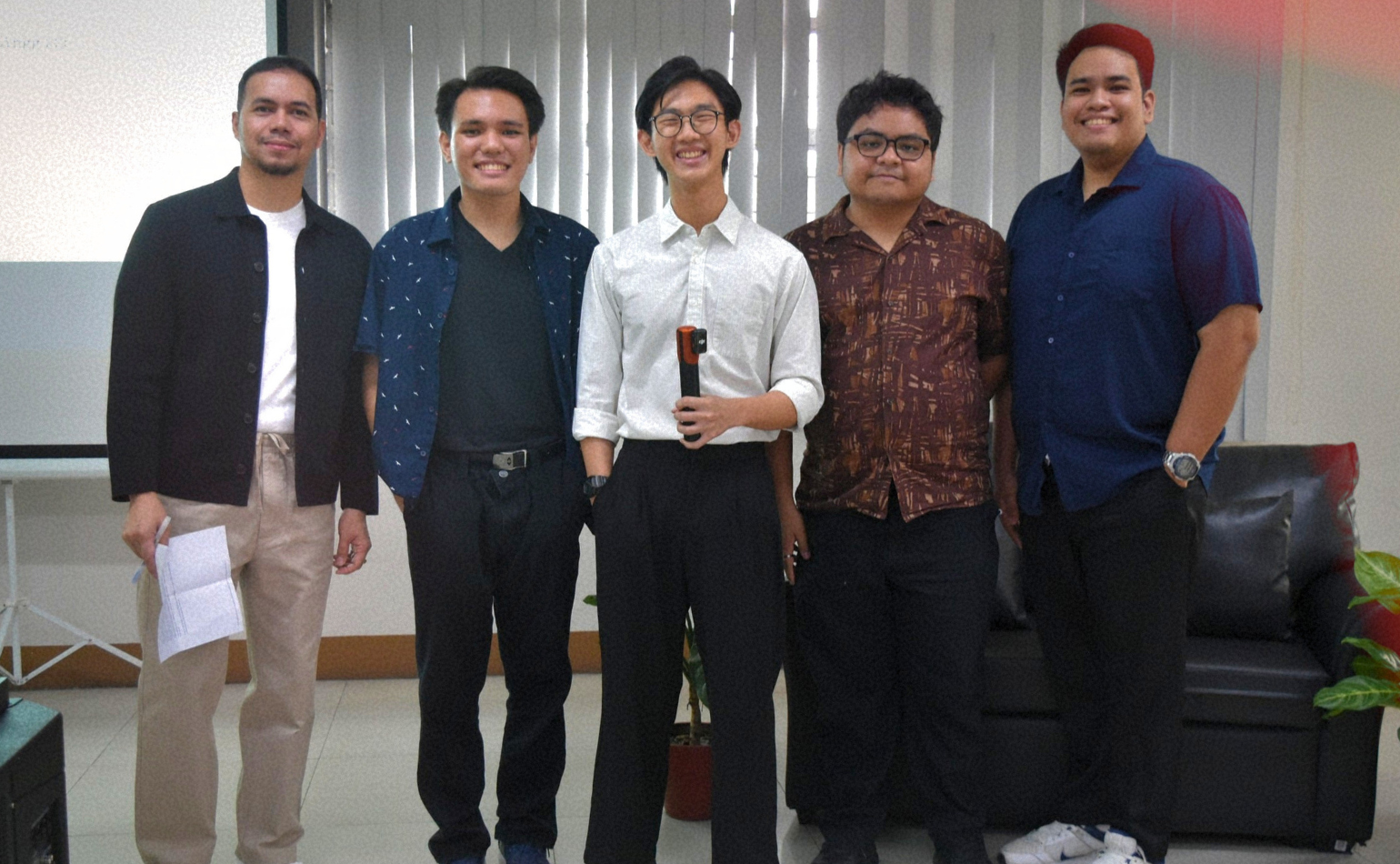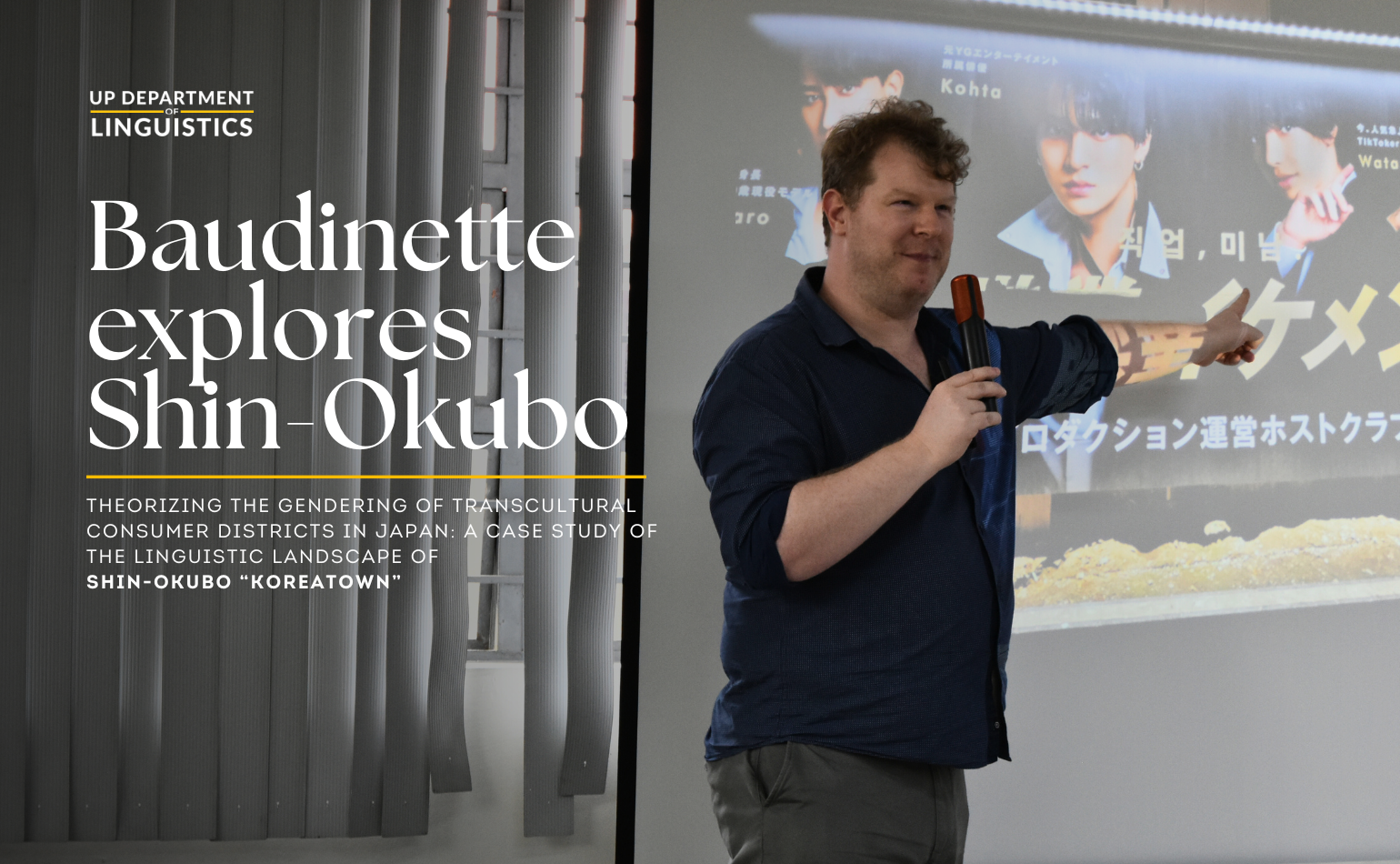
Last 26 January 2026, the Department of Linguistics in partnership with the UP Korea Research Center welcomed Thomas Baudinette, PhD, and Senior Lecturer in Global Studies at Macquarie University, Australia, to present a special lecture entitled “Theorizing the Gendering of Transcultural Consumer Districts in Japan: A Case Study of the Linguistic Landscape of Shin-Okubo ‘Koreatown’”. The lecture explores how Japanese consumerism culture intersects with how female fans, specifically, of Korean idol groups, support their favorite idols through examining the linguistic landscape of Shin-Okubo.
In line with Japanese culture, fandom activities tend to be divided by gender and types of fandom. Different districts, thus, become spaces for different fans to exercise fandom activities. Examples of these places in Japan include Akihabara which serve as a space for heterosexual male fans of anime and manga, Harajuku for the heterosexual female fans of the gothic lolita subculture, as well as male idol groups, and Ikebukuro which is for the heterosexual female fans of anime and manga. Another one of these places, which the Dr. Baudinette focuses on, is the Shin-Okubo “Koreatown,” a space for heterosexual female fans of Korean male idol groups.
Shin-Okubo has a rich history. Originally emerging in the 1980s and 1990s, it was a place that catered to Korean expatriates who came to Japan for work, and was predominantly a hospitality district. In the late 2000s, the place evolved into a space catering to fans of the Korean Wave (K-wave). The K-Wave boom started due to the explosive popularity of the Korean drama Winter Sonata when it aired in 2002 and was rebroadcast in 2003. Around this time, a majority of the fans of the K-wave were middle-aged females. K-pop, meanwhile, took a few more years to become popular. The first K-pop artists whose popularity exploded in Japan were TVXQ (SM Entertainment) and BoA (SM Entertainment), leading to the 2nd Korean Wave boom. At this time, K-drama and K-pop became “mainstream” in Japan and Korean acts were then also being invited to the prestigious New Year’s program, Kouhaku Uta Gassen (紅白歌合戦) on NHK, a prominent broadcasting station in Japan.
With this popularity came detractors. Conservatives with anti-Korean sentiments put forth demonstrations and complaints against Korean content. Among these is a manga by Yaamano Sharin called “Hating the Korean Wave” or Kenkanryuu (嫌韓流) which presented a revisionist history of Korea-Japanese relations. Protestors also rallied against Fuji TV, another prominent Japanese broadcasting station, due to the alleged “excessive” airtime given to Korean content. This resulted in the reduction of Korean content airtime by the station. The move ended up affecting businesses operating in Shin-Okubo with 80% facing bankruptcy.
In 2016, a renewed interest in K-pop emerged owing to the global success of idol groups like BTS and Blackpink, leading to a 3rd Korean Wave Boom. Shin-Okubo, seeing this new opportunity to revitalize their district, transformed from a Korea space to a K-pop space. Within the revitalized Shin-Okubo, K-pop is integrated in the streets and establishments. Hangeul, the Korean writing system, is used to add to the ‘Koreanness’ of the space. K-pop songs are playing, several cutouts of K-pop idols are on display, K-pop idol trainees walk by, and various merch for different idol groups are being sold throughout the space. This is a place where fans can practice oshikatsu (推し活) or the act of supporting their favorite idols through the consumption of goods for the purpose of popularizing and investing in them.
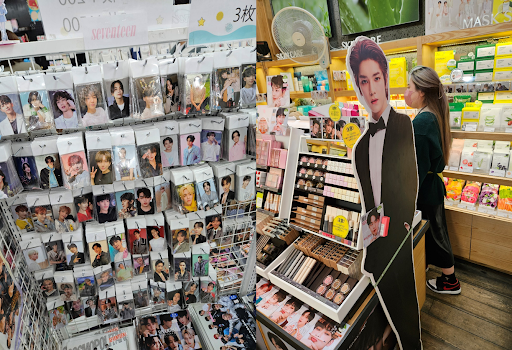
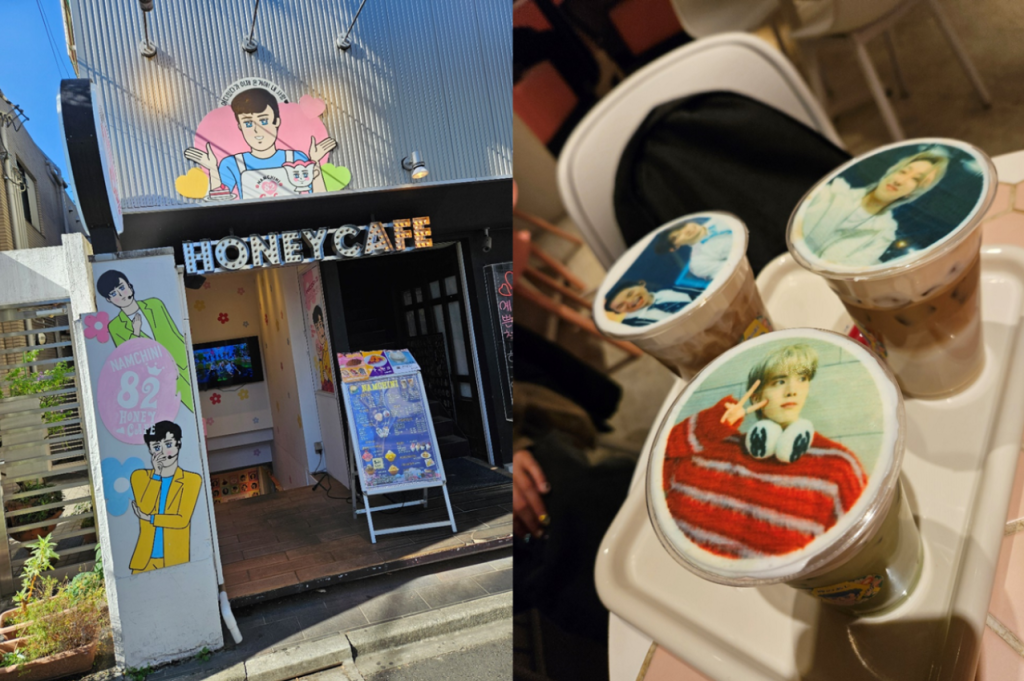
The type of merch being sold, the decorations of the place, and the types of establishments present show that Shin-Okubo is highly gendered. The focus of the decorations is always on male idols, with decorations of female idols being extremely rare. Establishments also almost exclusively cater to women, with romantically charged cafes where the customers are able to print a photo of their favorite male idols on top of their drink. Advertisements for a dating app specifically for Japanese women and Korean men can also be seen. In Kabukicho, a nearby red-light district, there are also host clubs that specifically cater to this audience, where a host being a former Korean idol trainee is considered a selling point.
Dr. Baudinette concludes that because of these, Shin-Okubo has become a safe space for heterosexual women to express their desires in a society where it is constantly denied. The practice of oshikatsu also provides a collective identity and potentially empowers the women practicing it by giving them agency. He also adds that this phenomenon is not constrained to Japan, but can also be seen in the Philippines through the various fan meets and tie-ins that bring K-Pop fans together and subsequently create spaces that empower them.
To read more on Dr. Baudinette’s work, you may read his special contribution to an issue of HanPil: Studies on Korea and the Philippines on the UP KRC website.
The recorded lecture can be accessed on the Department’s official YouTube Channel. Stay tuned for more lectures!
Published by Romina Joyce Y. Buan