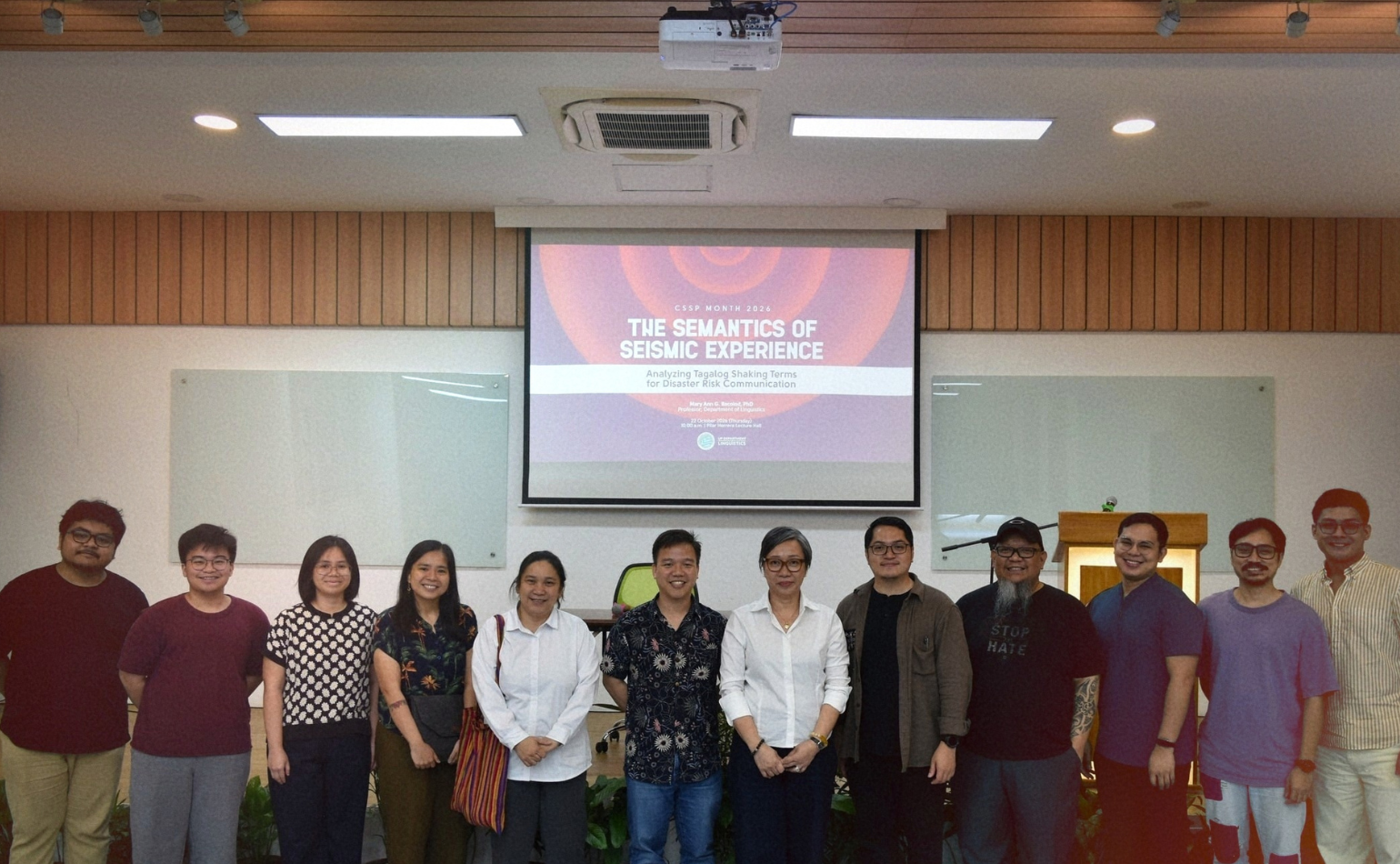
Last 22 October 2026, Prof. Mary Ann G. Bacolod, PhD, presented the findings of her research on shaking terms as they pertain to the Filipino disaster experience of lindol ‘earthquake.’ The talk entitled “The Semantics of Seismic Experience: Analyzing Tagalog Shaking Terms for Disaster Communication” was held at the Pilar Herrera Lecture Hall as part of the CSSP Month 2026 celebration.
Prof. Bacolod’s study aimed to find out how earthquakes are reported in local media as well as the different Tagalog words that the Filipino public use in their experience of this seismic event. She seeked to understand how the local lindol experience can be understood and utilized to make future disaster risk communication more effective.
There were three domains where risks were communicated: PHIVOLCS, the local media, and online public comments. It was observed that the experts of this subject area from PHIVOLCS tend to utilize technical jargon like “magnitude, intensity, aftershock” when describing lindol. Local media outlets often echo the usage of these technical descriptions while also reporting other specific details about the disaster.
But when it comes to the average Filipino’s experience, they tend to focus more on the details they can perceive e.g. how long the earthquake lasted and how many times it occurred. They told these accounts as they lived and experienced it. Prof. Bocolod identified three patterns in their lindol descriptions. These accounts were often locational, directional, and sensory in nature. For instance, people would recount what floor of the building they were in, the up-and-down motion they felt, and the sounds that they heard. Sensory descriptions were the most utilized of them all, and this category is further divided into auditory, motion, visual, and vestibular descriptions.
The speaker also touched on PHIVOLCS Earthquake Intensity Scale (PEIS). If one were to look up this scale online, one would discover that the different levels of shaking and their respective descriptions are written in English. In her talk, Prof. Bacolod presented the Tagalog version of the PEIS and several local shaking terms like imbayog and yugyog appeared. However, this was not necessarily a reflection of shaking terms used in daily life. Next, the speaker walked the audience through the various shaking terms she initially collected from Vicassan’s English-Pilipino Dictionary (1995) and the Austronesian Comparative Dictionary before narrowing it all down to the four most prominent shaking terms used in local media.
The first of these terms is yanig, meaning tremor or vibration. It was found to also be used in disaster contexts beyond earthquakes, in describing emotional trauma, and in painting the picture of some powerful and deafening event. The second term is alog, which means shake up or cause something to shake while the third term is uga, which means swaying or to swing back and forth. These two words also carry a different layer of connotation in Filipino media. Lastly, the fourth shaking term is yugyog, which means shaking up and down. This is another instance where the word itself also has a metaphoric use.
Local news outlets and the Filipino public tend to make use of all four terms, but yanig is the most prominent shaking term out of the four when it comes to describing earthquakes in particular. It is also the term that is most utilized by experts. Prof. Bacolod simplified the differences of the other three shaking terms in their movement. Alog is more vertical in its motion, uga is more horizontal, while yugyog is a combination of the two. The speaker sourced the definitions she used in this talk from various dictionaries like the UP Diksyunaryong Filipino (2010) and the KWF (2021) diksiyonaryo.ph to name a few.
Through this research, Prof. Bacolod concluded that decisions are influenced by how we perceive risk in a disaster. Sensory verbs were found to be central to the Filipino experience of earthquakes in order to facilitate understanding and immediate situational awareness. Thus, qualitative descriptions of shaking can encourage more proactive action during calamities. The speaker also called for the treatment of the public as active agents capable of making decisions and taking actions instead of reducing them to the role of passive observers.
Before the event concluded, Prof. Bacolod took several questions from members of the audience where she responded to their queries and comments. Assoc. Prof. Jem R. Javier served as the moderator of the event.
Photos by Corinne Cedo
Published by Syafiqah Rahma Basiril