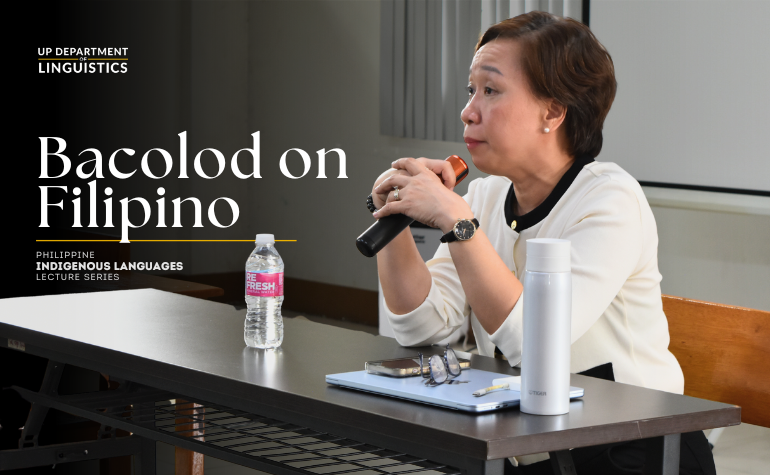
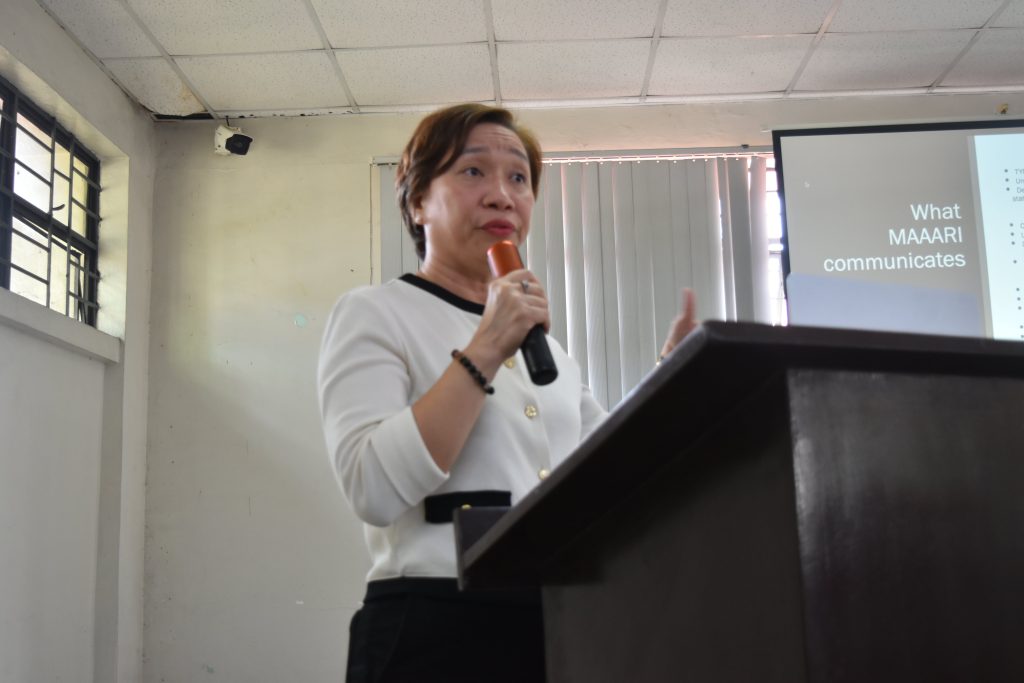
Last November 20, Prof. Mary Ann G. Bacolod presented her study that focuses on the effects of modals when communicating urgency in times of disaster emergency. Her lecture, “Navigating the Storm: Understanding the Role of Filipino Modals in Disaster Risk Communication,” served as the eleventh installment of this year’s Philippine Indigenous Languages Lecture Series (PILLS).
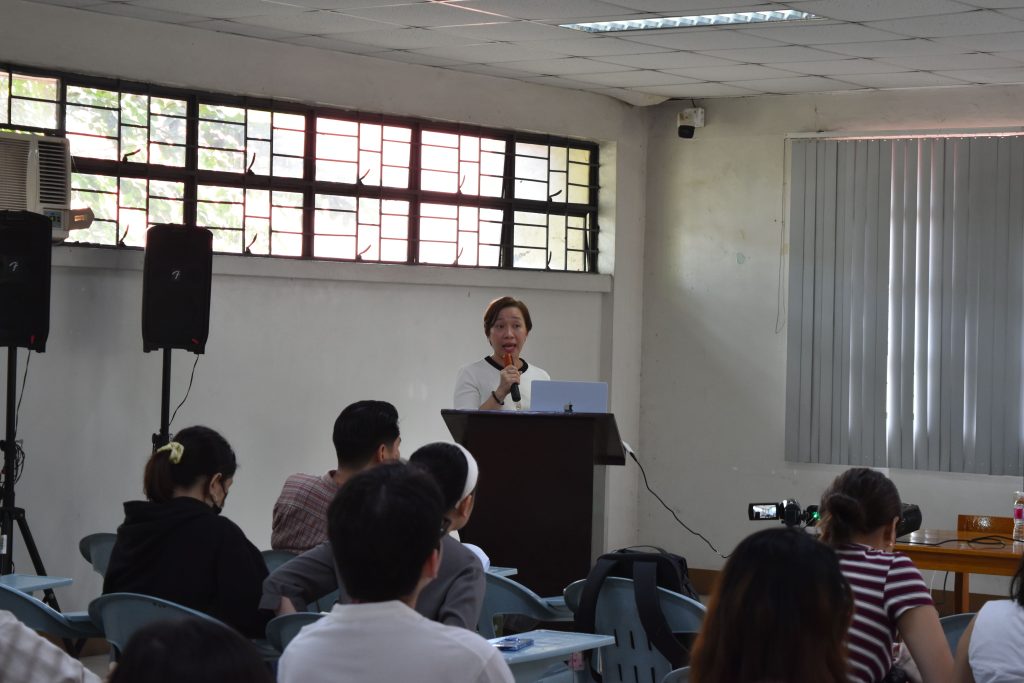
To provide an idea of how modals figure in disaster risk communication, Prof. Bacolod asked the audience to picture a scenario and think about how they will deal with the situation: In the midst of a super typhoon, the public receives an announcement: Kailangang lumabas na ng Palma Hall ang lahat (‘Everyone must now leave/evacuate Palma Hall’). She then inquired how the audience will react upon hearing similar statements containing the modals dapat, maaari, posible, and pwede, noting in the end that such prompts are often interpreted differently by individuals.
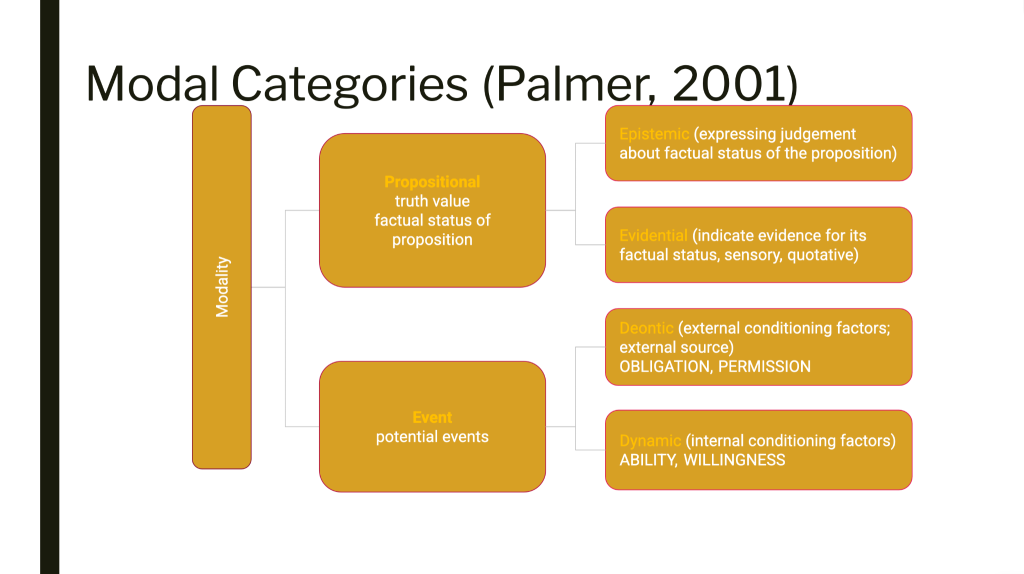
Prof. Bacolod cited Sokolova (2020) who defines modality as “a way of expressing [a] person’s attitude to the content of the statement, the relation of the content of statement to objective reality” where “[a] speaker [chooses] the means of expressing modality to indicate whether the action denoted by the verb… is true / false, possible / impossible, obligatory / optional, desirable / undesirable, etc.” (p. 23). She also discussed the modal categories identified by Palmer (2001), to demonstrate the finer distinctions between modals, before giving an overview of key works that characterize modality in Filipino [fil] (i.e., Schachter & Otanes, 1972; Malicsi, 2013).
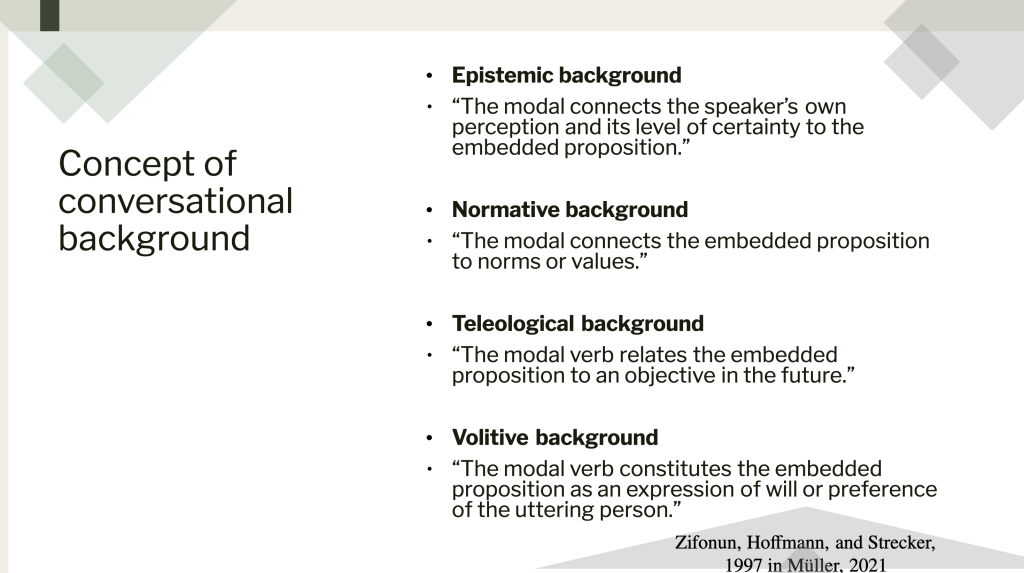
The current study examined news articles about common disaster categories, i.e., typhoon, flood, volcanic eruption, COVID-19, by means of semantic and contextual analyses, and looked at five kinds of modals found in online newspapers: kailangan, connoting internal necessity or need; dapat, connoting external necessity or appropriateness; and maaari, pwede, and posible, denoting ability, permission, or possibility. Meanwhile, the characterization of the contexts wherein modals are used to frame disaster-related information was drawn from Zifonnun et al.’s (1997) concept of conversational background (as cited in Müller, 2021).

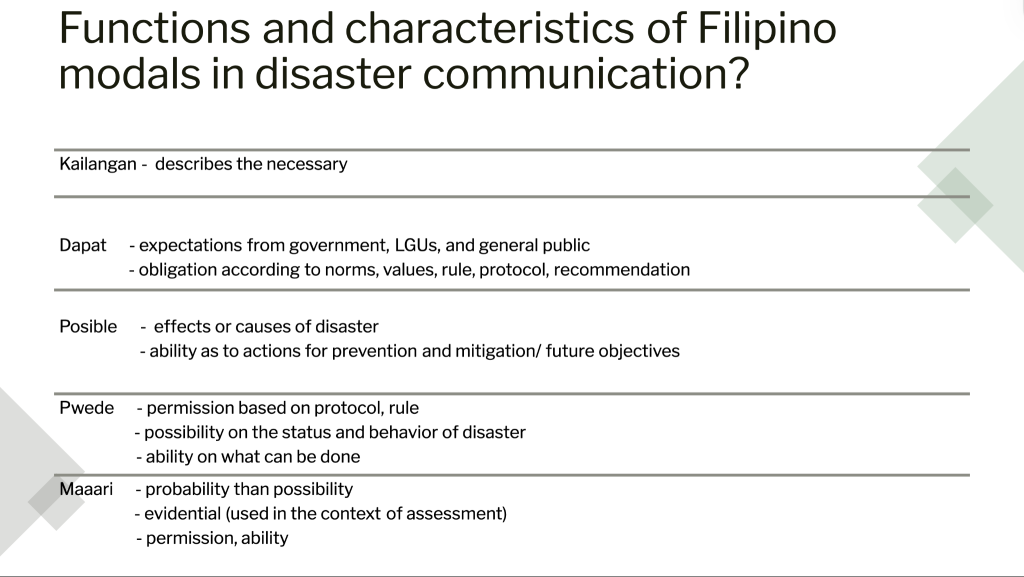
Maaari has the following functions: epistemic, which pertains to possibility; deontic, which involves permission; and dynamic, which relates to ability. In terms of the background of conversation, maaari is commonly found in articles with either epistemic or circumstantial enabling background. Additionally, usage of maaari in news about typhoons and volcanic eruptions expresses uncertainty and obligation, specifically by describing the unpredictable nature, behavior, and state of such disasters. Similarly, in COVID-19 news articles, maaari describes the unpredictable state and effect of the disease, as well as what the government and the people can and may do during the pandemic. In the case of news about flooding, maaari alludes to what is allowed; the nature and state of a place/location where flooding happened; and the idea of a lesser extent of uncertainty, considering the cyclical nature of flooding.
Dapat generally serves a deontic function, where a distinction between internal and external obligation can also be made. The contexts where this modal is used are either teleological, concerned with an obligation specific to a particular or future objective, or normative, wherein obligation is based on rules, values, and protocols. These contexts collectively reflect the goals of planning for, mitigating, and/or preventing hazards. Bacolod emphasized that in typhoon and volcanic eruption articles, dapat communicates what is required and what the speaker thinks is necessary. In COVID-19 articles, it describes the obligation of the people and the government during health emergencies, while in flooding articles, it also points out what can be done.
Kailangan, like dapat, also indicates a deontic function and is common in conversations which are teleological in nature. However, unlike dapat, it mainly alludes to necessity rather than obligation. Usage of kailangan in news about typhoons is minimal, but it often relates to assessment, or what needs to be done after the inception of typhoons. In volcanic eruption and flooding articles, this modal signals necessary actions related to safety and damage control, while it emphasizes the obligation directed to the government and the public in COVID-19 articles.
Pwede can be associated with two main functions, i.e., epistemic and deontic, and a variety of conversational backgrounds, i.e., circumstantial-enabling, circumstantial-restrictive, and epistemic. Pwede also expresses the following in relation to the four disaster categories: for typhoons, uncertainty; for volcanic eruptions, possibility; for flooding, permission in flood-related communications; and for COVID-19, ability and permission/restriction rather than uncertainty.
Lastly, posible has either an epistemic or evidential function, and is found in news articles with epistemic conversational background. Posible also presents facts (evidence) about the status of typhoon or volcanic activity with the use of conjunctions ayon sa ‘according to’ or batay sa ‘based on’; and communicates assumption for flooding.
Prof. Bacolod summarized the functions and characteristics of Filipino modals in disaster communication, as shown below:
Furthermore, she highlighted how information regarding disasters are usually relayed through modals in Filipino.
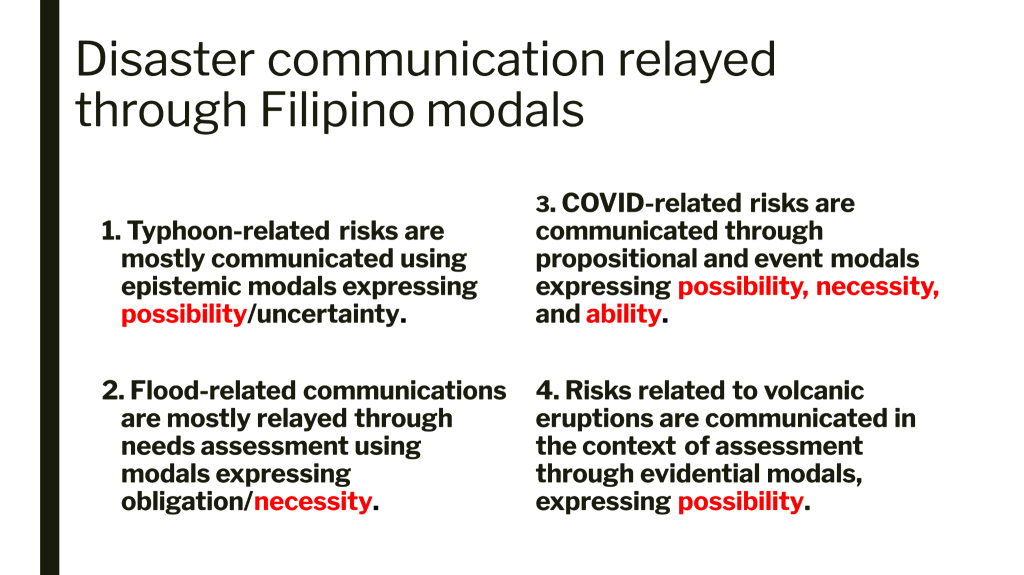
Ultimately, in expounding why this kind of study matters, Prof. Bacolod stressed the following points. First, modals “communicate the necessary, the obligatory, and the uncertainties in the context of disaster.” Second, understanding modality is necessary in evaluating information that leads to proper interpretation and decision-making. Third, usage of appropriate modals aids in gauging “the urgency or non-urgency of communicated risk in disaster context.” Finally, apart from an assessment of how disaster risk is communicated, such work “could help in refining disaster risk information and communication.”
Some questions and comments from the audience during the open forum were about the distinction between maaari and pwede, two modals commonly differentiated based on perceived formality; the possibility of miscommunicating information on social media posts that use AI-generated translations; and the limitations of official announcements and alert messages written in Filipino or English, primarily in the context of speakers of other Philippine languages.
This lecture can now be viewed on the Department’s YouTube channel. Prof. Bacolod also previously published an article on translation issues in disaster communication, where she examined “the functions and meanings of modals used to express possibility and obligation” in English and Filipino.
This installment of PILLS 2025 was moderated by Asst. Prof. Vincent Christopher A. Santiago.
Published by Patricia Anne Y. Asuncion