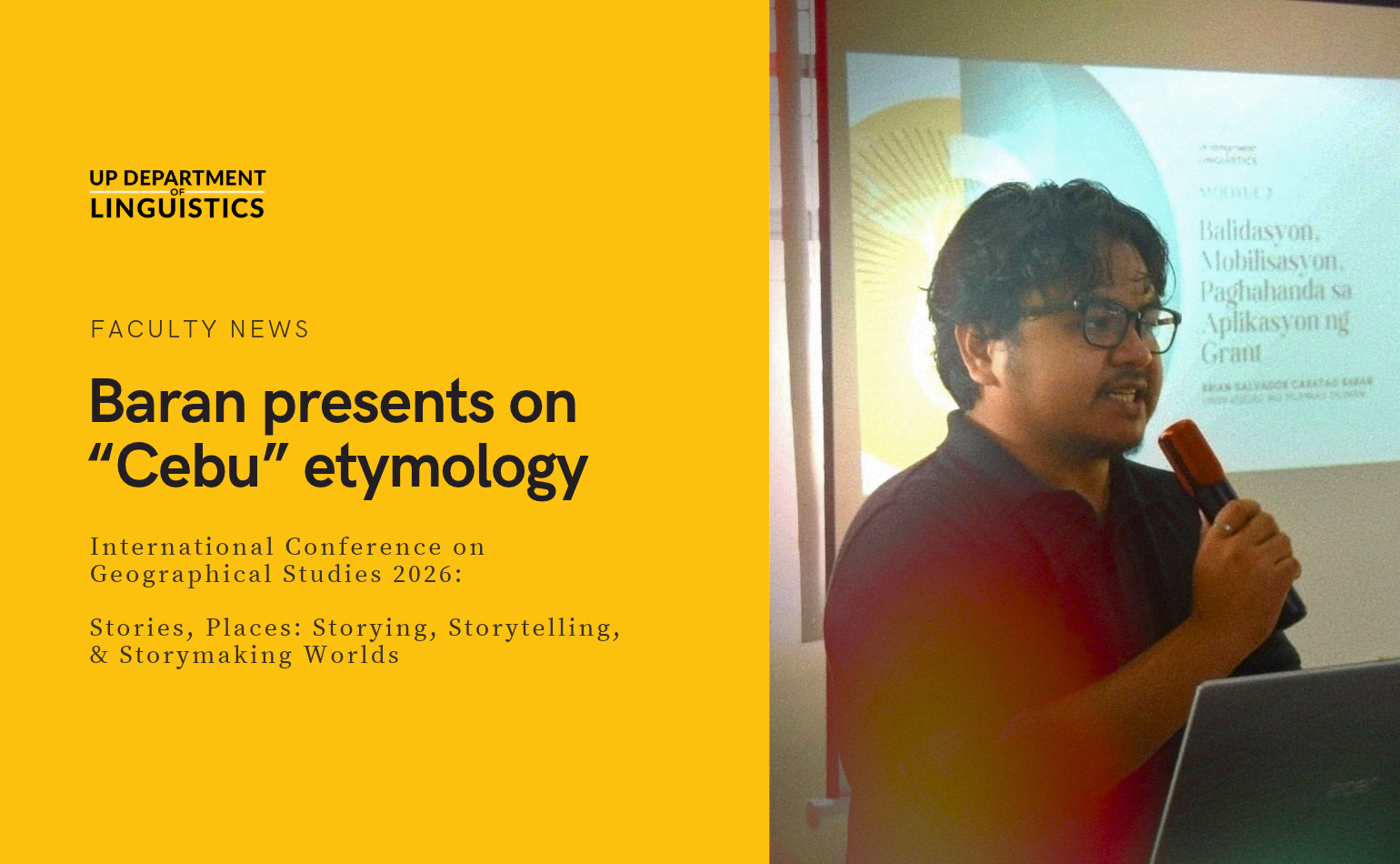
Instr. Brian Salvador Brian recently read his paper, “The Razing and Submerging of *sug(e)bu (and why we [the folk] need a good story to toponym etymologies),” at the International Conference on Geographical Studies 2026 (ICGS 2026) last 13 November 2026.
Below is the abstract of the paper:
The Razing and Submerging of *sug(e)bu (and why we [the folk] need a good story to toponym etymologies)
Cebu, Philippines—several proposals for the etymology of my hometown’s name have been surfaced in its back-and-forth from Cebu to Sugbo. The most well supported etymology traces both to a Cebuano/Binisayâ (ISO 639-3 [ceb]) sugbo ‘to dive into water’ source which ultimately springs from the Proto-Philippine (PPh) *sug(e)bu ‘to wade into water’. This etymology has been infused in the Cebuano historical stream by way of former Cebu governer Dionisio Jakosalem’s “Los pueblos de la isla de Cebú, y los significados—Etimologicos de sus nombres” (1910) and later, Resil Mojares’ “The History of the Province of Cebu” (2014), sanctioned by the Provincial Government. Nevertheless, alternative etymologies continue to be floated ranging from the most popular sugbo ‘to raze/scorch’ and sinibuayng hingpit ‘place of trading’ down to the least accepted sebo ‘grease’ and Francisco Alcina’s (1668) sugbo ‘sad, to shoulder’. ‘To scorch’ and sinibuayng hingpit in particular likely spring from Jovito Abellana’s record of the supposed Cebuano epic, “Aginid Bayok sa Atong Tawarik” (1952)—now widely believed to be a hoax. Both remain afloat by anchoring Cebu to a “radiant” Cebuano past while *sug(e)bu is legitimized through the imagining of a Cebuano island present and maritime future. This exploration attempts to retell this confluence of etymologies, history, historical linguistics, and nationalist fiction and in the process, foreground the place of toponyms and our [folk] etymologies of them as not only symbols of place, but also as stories we use to navigate ourselves towards our place in the world.
Published by UP Department of Linguistics