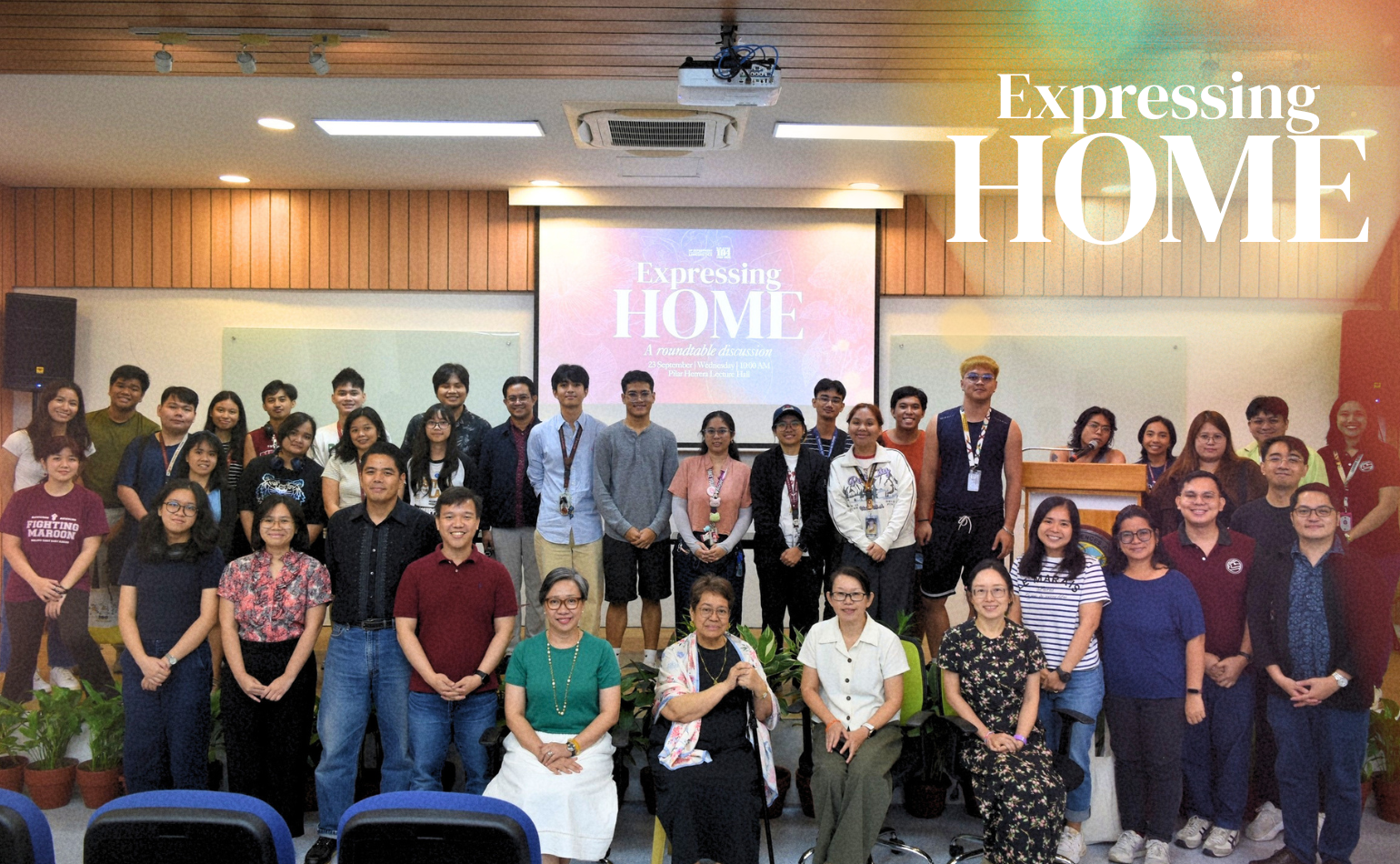
Last 23 September 2026, the Department organized a roundtable discussion entitled “Expressing Home” at the Pilar Herrera Lecture Hall as part of the celebration of the 2026 Lingg Month. The discussion explored the concept of home and its perception, meaning, and creation in different contexts.
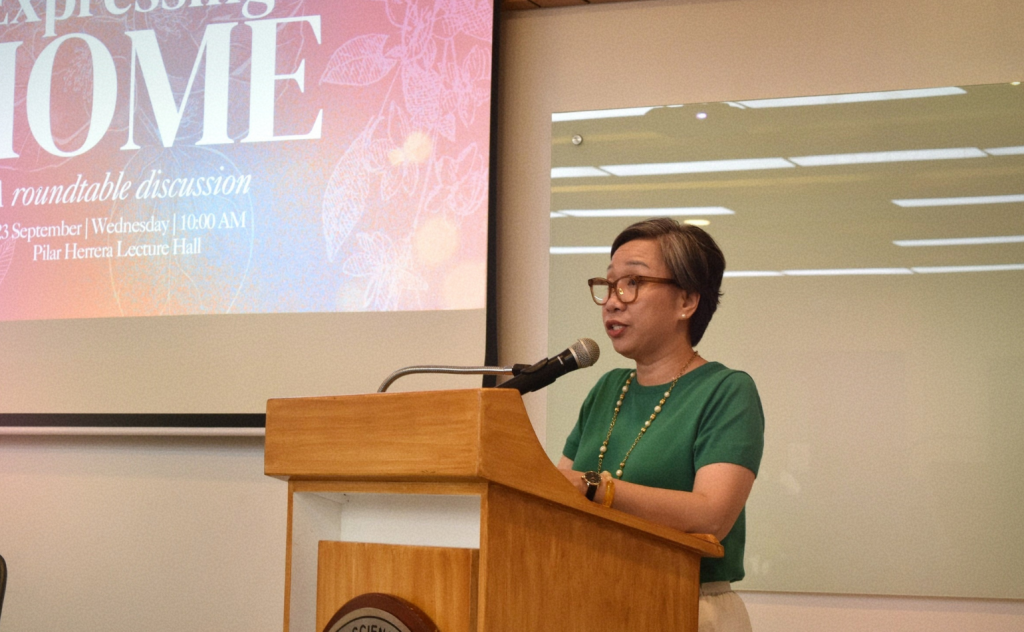
Prof. Emeritus Elena Rivera Mirano of the Department of Art Studies first presented “Huluna: Ang Tinig ng Tahanan,” which highlights lullabies as the most intimate musical form performed only within the home in Southwestern Batangas. The form and style of particular musical forms we grew up with usually goes unrecognized, which is the case with huluna and the music of the larong pambata. The huluna is not exposed to the public, as it is sung privately by the parent to lull a child to a comforting sleep. The lullaby is unmetered and free flowing, having a quiet breathing rhythm. It is also characterized by abrupt unpredictable movements, which also reflects the lyrics in the huluna that portrays the parent’s fears. This includes situations where the child starves, wanders off, or is given away to religious authority in a small container or burial jar as they are separated from their parents, particularly reflecting how children were sent to Catholic convents during the 1970s. This impending parental separation is not typically discussed in public but is depicted in the huluna, thus acting as a protective embrace for the child as it is sung.
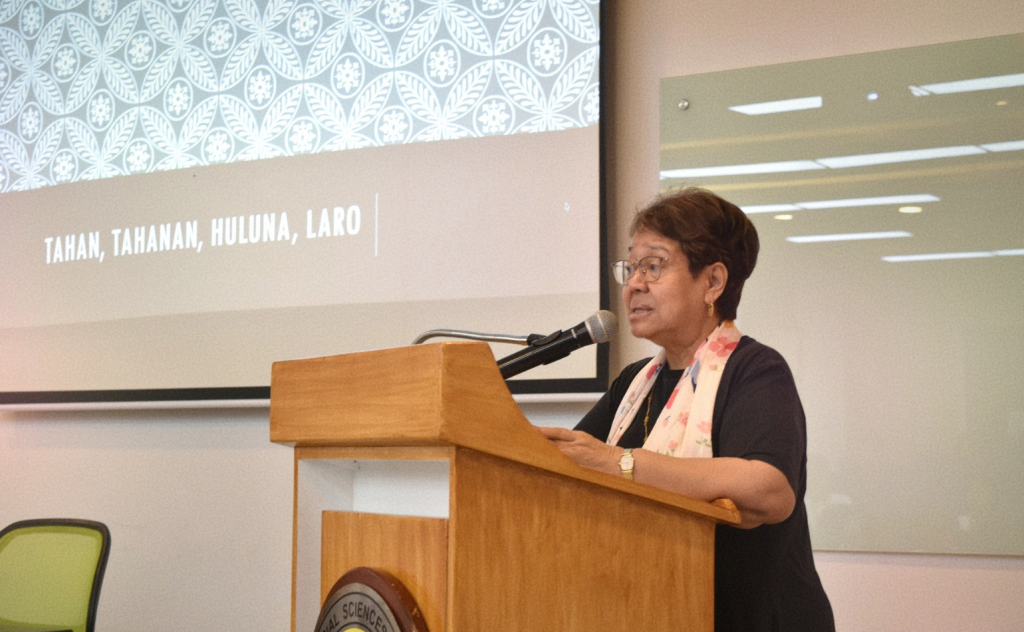
Outside of home are the music of the larong pambata, which are not as private but are still worth observing. The larong pambata are opportunities to test or showcase children’s physical skills and body control. This is also where they learn how to compete or coordinate with their peers, and act according to the enforced rules of the game. The songs in larong pambata are characterized by their rhythmic and simple melodies that are easy to follow and are synchronized with physical movements such as clapping and stomping. The chants are usually deemed unintelligible, having no rhyme or reason. But when closely examined, language borrowing can be seen such as in jak en poy and penpen de sarapen. Like the huluna, some songs may also reference the danger of the child’s separation from parents and being sold away for servitude, as in the third and fourth verses of Sitsiritsit, Alibangbang. In contrast to the huluna, the larong pambata happens outside the comfort of one’s home, where a child is exposed to variants of dangers or the risk of losing. Dr. Mirano discussed that becoming the taya or the loser can be a source of frustration for a child, who weeps as they return home. Tahanan can thus be a place of protection that one returns to when they need to heal. At home, the parents say the phrase “tahan na” to either console and comfort the child, or teach them to endure the harsh parts of the world and regulate their emotions.
Asst. Prof. Kyung Min Bae, the second speaker, meanwhile presented “Jib (집): Here and/or There,” which recounts her anecdotes and experiences while living in the Philippines, along with finding home and belonging.
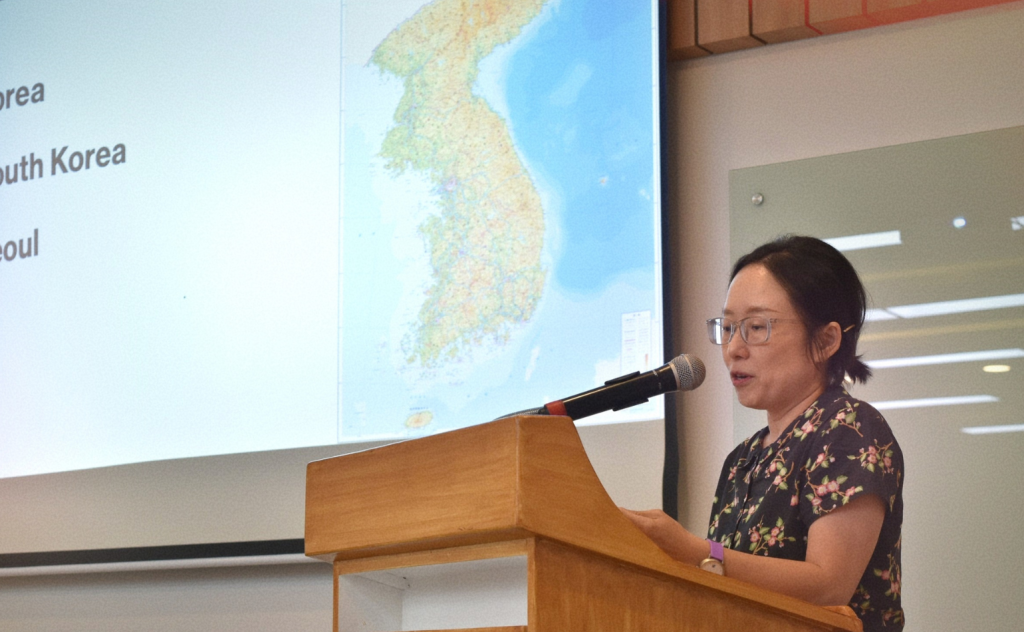
Since she was young, Dr. Bae had already been used to not having a permanent home as her family was always moving around. Her father, a military man, was always stationed at different places in South Korea, such as Jeju, Bucheon, and Daegu. Feeling as though her life was centered on movement, she ponders whether her birthplace, Seoul, is home to her or simply an advanced city she can discuss. She emphasized how outsiders are defined in a society, particularly within a nation. In Korea, people who are called 이주민 ijumin ‘immigrant’ and 이방인 ibangin ‘outsider; stranger,’ typically marriage migrants and migrant workers, are not fully accepted as part of Korean society. Dr. Bae experiences the same in the Philippines, wherein she sometimes feels like an outsider whenever she receives questions about her ethnicity. She also talked about her struggle in filling up application forms that require your address. She explained how she was unsure what address to write under temporary residence and permanent residence, and whether or not they are the same place to her. She was also hesitant to put her address in Seoul as her permanent residence. She felt conscious as a dayuhan or foreigner, feeling like a stranger to locals as she is seen as either Chinese or Singaporean most of the time, so engaging in Philippine culture felt more intentional. However, in one of her anecdotes recalling when she confirmed her permanent residence in the Philippines, she eventually realized how she started to do it unconsciously, as someone who lives here. It became clear to her that she is home, an emotional affect that stemmed from the conscious effort to be part of the country. She has accepted the feeling of being somewhat a half-citizen, as she still gets asked about what country she came from, but home to her does not have to be what is seen in the passport. As a response to what people usually ask about her stay in the Philippines, she emphasized that: “If I wasn’t happy here, I was already gone.”
Asst. Prof. Kritsana Canilao’s presentation, “Recalling and Reminiscing about ‘bâan’: Living Houses and Loving Homes in Thai Society,” discussed the history and semantic shifts of the Thai word bâan and the concept of home developed along with the physical structures of Thai traditional houses and their elements. There were two notable terms that refer to homes during the early Sukhothai period. On a microscale, the word เรือน ruean was used for ‘a physical structure, an individual house or a family dwelling’. In contrast, บ้าน bâan was used for a wider scope, referring to ‘a community or village where multiple households lived together’. This had changed through time as it underwent semantic shifts and eventually gained the meaning ‘house.’ Bâan is also used in compound words, such as บ้านเมือง baan-mueang ‘country/nation’ and บ้านเกิด bâan-koet ‘hometown/birthplace’. The terms bâan and ruean can also be combined to form บ้านเรือน baan-ruean ‘housing/dwellings/neighborhoods’.
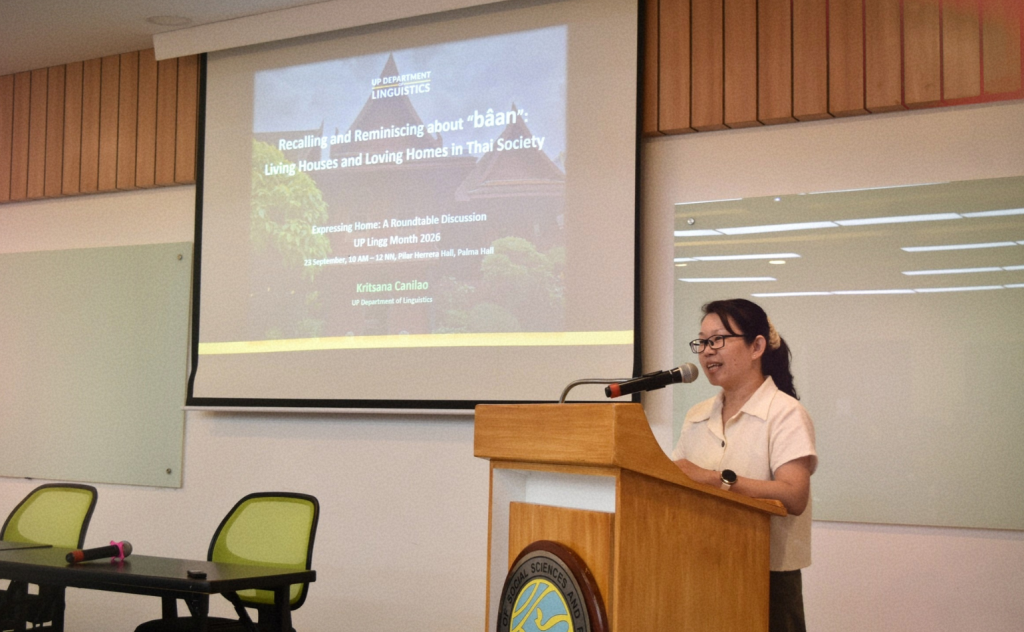
Dr. Canilao also showed the prominent features of traditional Thai houses (ruean thai), as well as the figurative aspects of bâan, including spiritual beliefs and rituals. In terms of their physical structure, traditional Thai houses were raised on stilts that served as protection from seasonal floods. There is also an open-air wooden deck or an open verandah called châan that acts as a main gathering space for family members. In addition, the houses were made with teak wood held together by interlocking joinery systems, making the structures easily expandable to accommodate the growing families. Along with the Thai houses, there are also Spirit Houses (San Phra Phum) to honor the ancestors who are believed to protect the house and the family. Given this, the word bâan thus embodies both the meaning of ‘house’ and ‘home’, emphasizing the sense of belonging and safety drawn from its communal roots. Although rapid urbanization has led to the replacement of traditional houses with concrete ones, architects still incorporate elements from the traditional Thai houses, such as the ancestral shrine spaces, to maintain the identity of bâan. Dr. Canilao concludes by emphasizing how home is tied to our identity, as it is expressed in language, songs, and evolving cultural terms. Home is where we are protected, nurture communities, continuously practice our care for our families, and exercise our grounding identity.
Prof. Mary Ann G. Bacolod served as the moderator for the event. Congratulations to all speakers, and stay tuned for more announcements on our future workshops and lectures!
Photos by Corinne Cedo
Published by Janna Isabel Basila