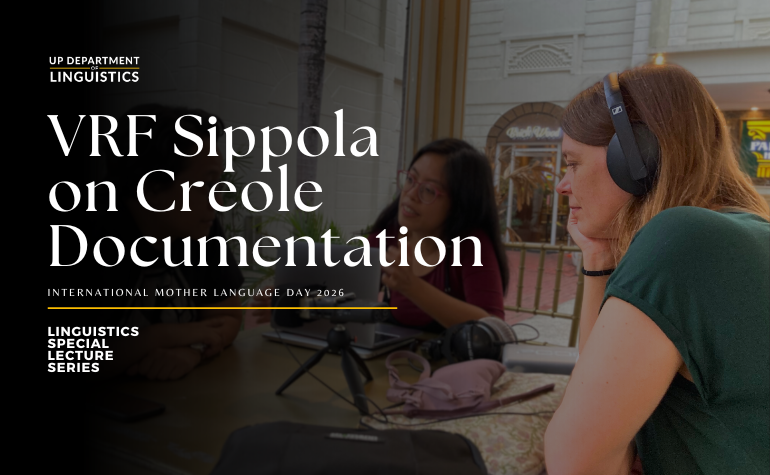
Last 21 February 2026, Visiting Research Fellow (VRF) Eeva M. Sippola, Professor from the University of Helsinki, Finland, gave a talk entitled Sustainable Language Documentation in Creole Settings. The talk is the second installment of the 2026 Linguistics Special Lecture Series (LSLS) and was held as part of a back-to-back lecture celebrating International Mother Language Day (IMLD) 2026.
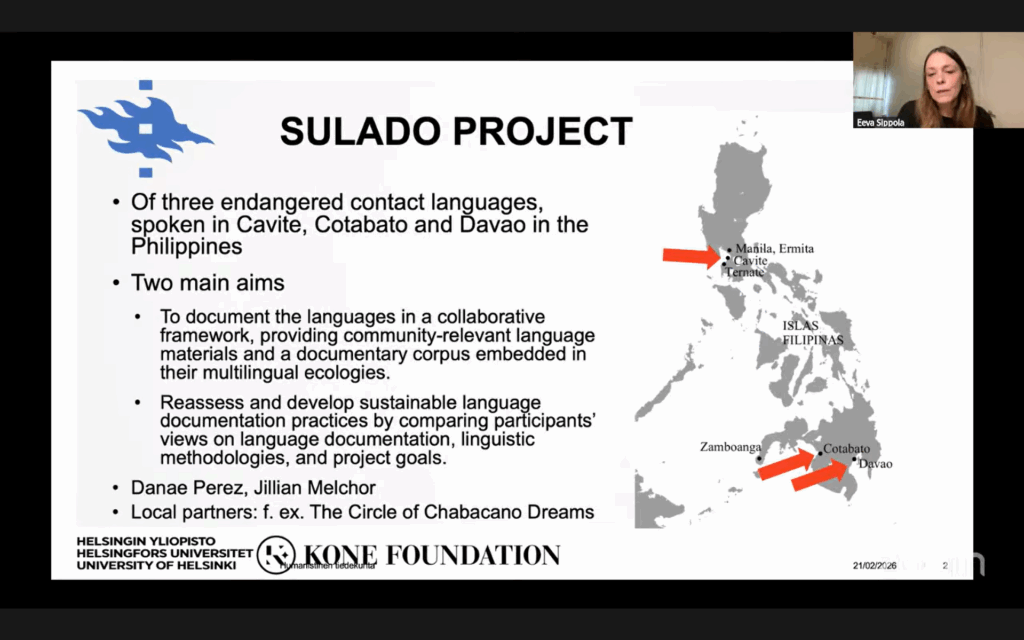
In the talk, VRF Sippola discusses her experiences and practices as they undertake the Sulado Project, which aims to document the Chabacano Creole (ISO 639-3 [cbk])in the Philippines, spoken in several parts of the country like Cavite, Ternate, Zamboanga, and possibly in Davao and Cotabato. With this, Sippola aimed to reassess how language can be documented sustainably in the context of creole languages. In particular, she sought to identify sustainable practices in the collection and analysis of language as well as the methodological and ethical concerns regarding language documentation.
Sippola emphasized ethical research practices and how they should be done. Informed consent should sougbht from participants and if they wish, they should be granted anonymity and—along with the community—be granted access to the archived materials. She underscored the obligation of researchers to be open and honest and with that, to secure any permissions needed for the research.
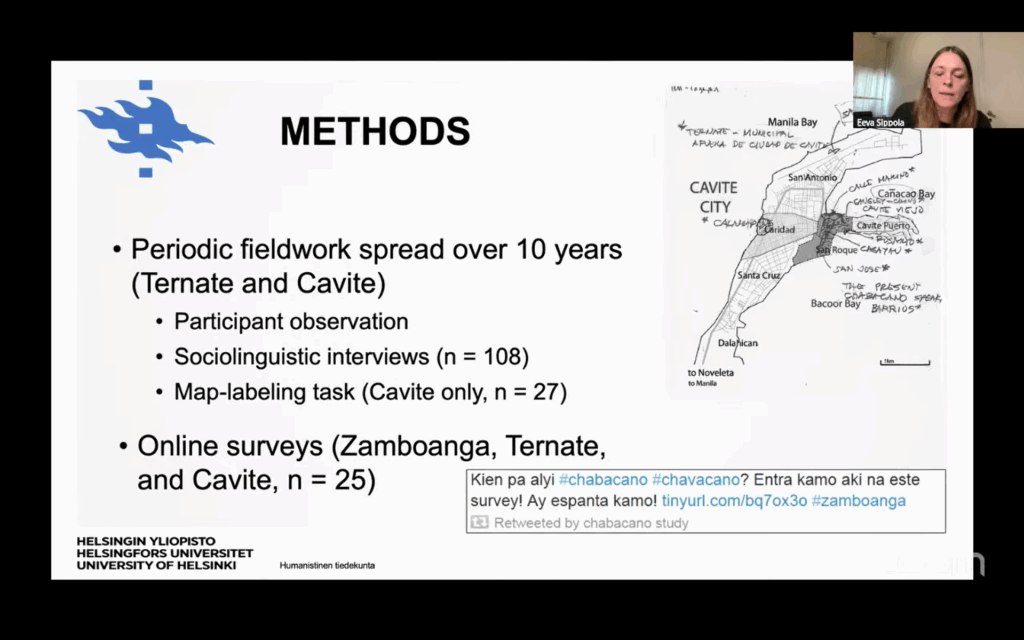
Sippola then went on to discuss the difficulties of documenting Creole languages in particular. Creole languages are often defined as being born out of two distinct languages spoken by multilingual communities. In this case, Spanish and a Philippine language. In such communities, language hierarchies are present, with the creole languages frequently being seen as the “lesser” language of the repertoire. As a result, some creole languages face endangerment with only a few fluent speakers remaining. This was true for their study of Chabacano speakers of Cavite, but this was not the case in Ternate.
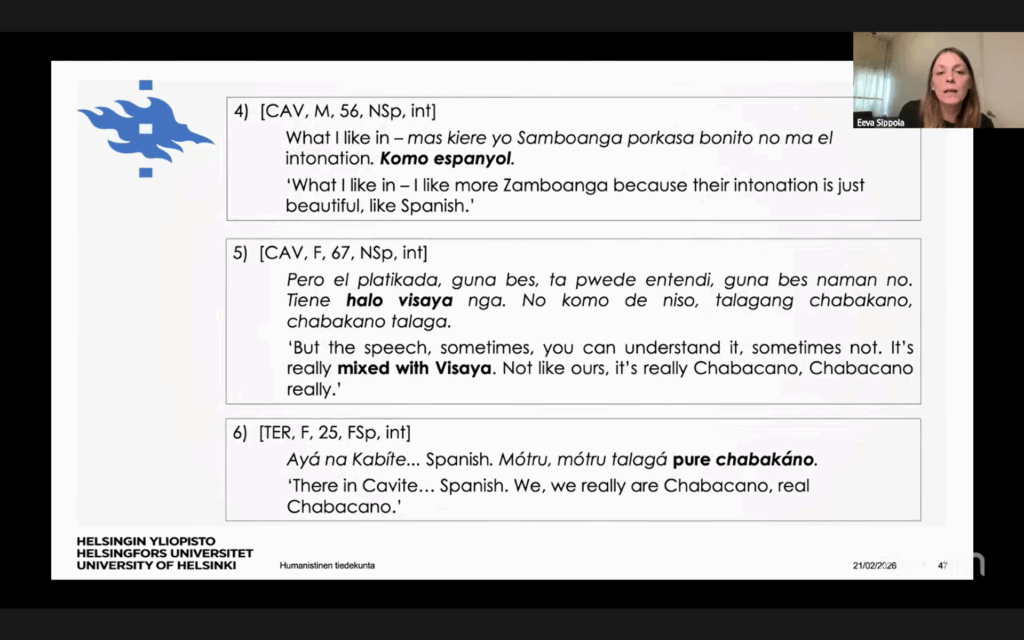
So far, Sippola has shown that Chabacano that speakers of the different Chabacano varieties have similar beliefs regarding what makes their language unique, and that they continue to perceive Spanish as a prestigious language, while Philippine languages are seen as a threat. This information was elicited from the speakers themselves. She further explains that eliciting language ideologies is advantageous in that it helps avoid biases, learn about the community’s perceptions, and provides a holistic view of both the linguistic structure and the sociolinguistic situation of the speakers.
After the talk, a question and answer portion was held, with questions from the viewers as well as professors regarding combating prejudice against Chabacano speakers and Sippola and team’s fieldwork experiences, among others.
The recorded lecture can be accessed on the Department’s official YouTube Channel. The third installment of the 2026 LSLS will be on A Corpus-based Approach to Explore how Children Acquire Batangas Tagalog in their Natural Environment to be delivered by VRF Eva Huber.
Published by Romina Joyce Y. Buan