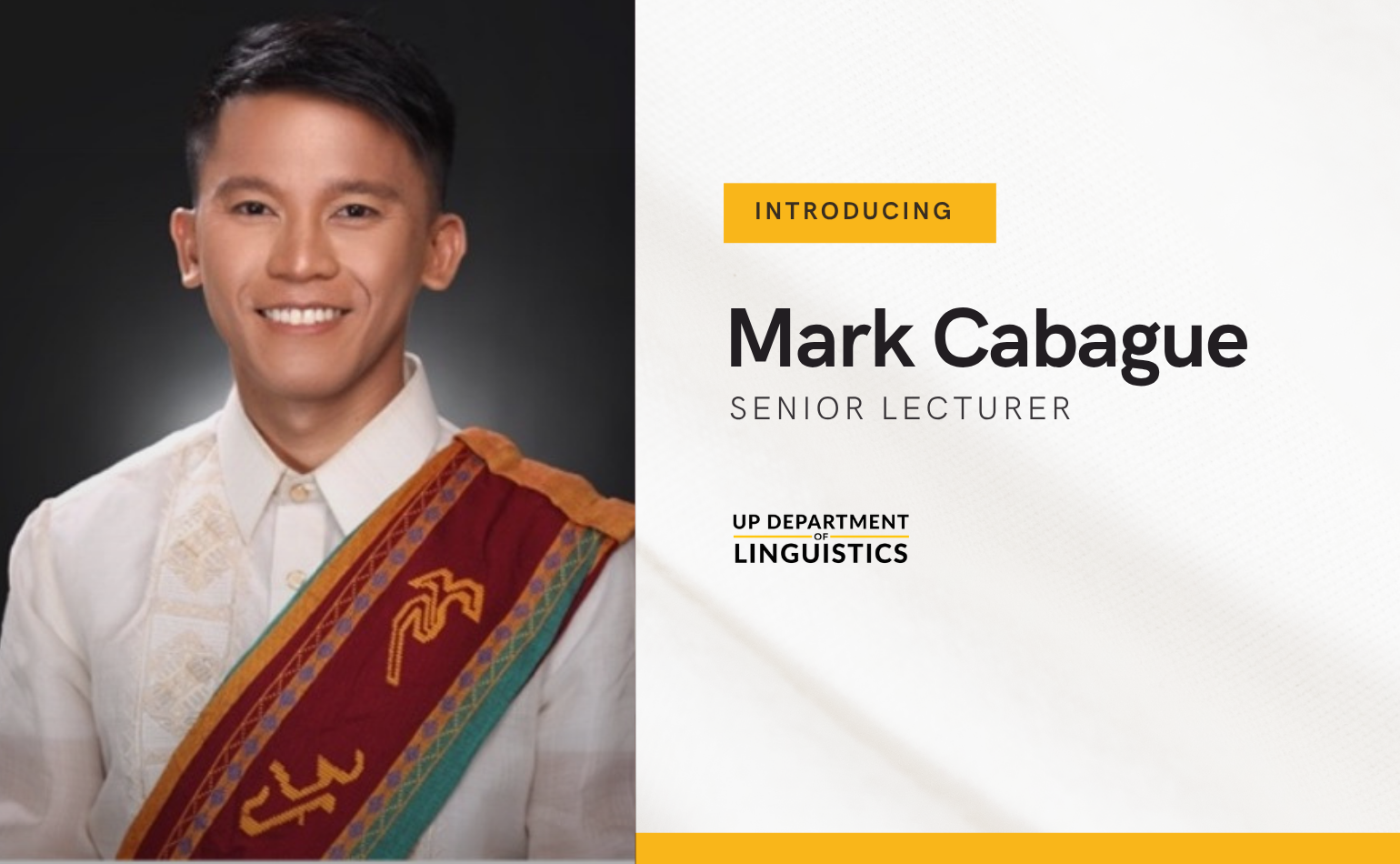
We are very pleased to announce that Senior Lecturer Mark Cabague will be joining the Department’s teaching roster this A.Y. 2026-2027! Read on to get to know more about one of our newest faculty members!
1. What got you into Intsik?
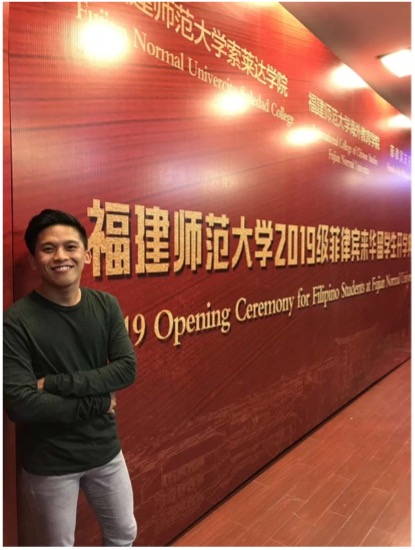
Honestly, I was just encouraged by a friend back in college to join the program offered by the Confucius Institute at Angeles University Foundation. We attended the free classes and after a year of study, successfully passed HSK 3 when we were just 17 years old. The institution provided us scholarship to go to Fujian Normal University in China to study Chinese language for one year. But unfortunately, I was not able to go because of discrepancies with my papers. Due to the disappointment, I had already decided not to continue pursuing Chinese, but Chinese teachers encouraged me to give it another chance. After turning 18 years old (legal age), I went to China to study one-year language program (2014-2015). Looking back, that decision became a turning point in my life.
2. Can you tell us more about your background?
I took up Bachelor of Secondary Education, major in Mathematics but after the one year language immersion in China, the program was integrated with my undergraduate curriculum which allowed me to complete a 5-year double degree program (BSEd Mathematics and Chinese Language Teaching). Because of my Chinese language skill, I was able to do part-time teaching jobs during my remaining college days. After graduating in 2017, I applied for another scholarship for MA and worked as interpreter in a manufacturing company while preparing for the licensure examination for teachers (LET). Fortunately, I got accepted and flew back to China right after the licensure exam to pursue Master of Teaching Chinese to Speakers of Other Languages (MTCSOL). After few months of studying there, I got the good news that I had passed the licensure exam. After completing my first year, I came back to the country to complete teaching practicum requirements of the MA program and then went back to China to continue my second year. I was already working on my thesis when the COVID-19 pandemic began. I had decided to come home and continue my thesis in the country. Upon returning, I entered the corporate world and worked as Mandarin-Speaking Customer Service Representative. And after a year of juggling work and academics, I successfully finished my thesis and passed the thesis defense. In 2021, I earned my first MA degree. Due to the impact of economic change, the account where I work closed, so I applied for a new job into the shared services industry under the procurement department. Seeing the huge potential of bigger opportunities available in the corporate sector, I pursued another MA program (Master of Management) at UPDEPP to further strengthen my knowledge in business. After gaining nearly 3 years of experience in procurement, I moved to another company where I work now as Mandarin Procurement Specialist. Once again balancing work and graduate studies, I successfully finished my degree last July 2026 before I entered to teach in UP Diliman.
3. What are some of the highlights of your experience in learning the language?
There are 3 stories I would like to highlight. First is a funny story that happened when I was in the grocery store in China looking for some eggs to buy. But the products had been rearranged and I couldn’t find the eggs. At that time, I was not yet fluent in Mandarin, so I asked one of the staffs in English. Since he could not understand me, I ended up imitating a chicken and gesturing the shape of the eggs in my hand. He finally understood and guided me to the egg section while both of us laughing about it.
Second is when I cried alone in my room because learning Chinese felt overwhelming. The lessons were just way too difficult for me that I struggle so much to keep up during class the as there were just so many unfamiliar words. But I persevered and slowly adapted. Over time, I improved and gained confidence in the language.
Lastly is the friends I gained from different parts of the world. Learning Chinese gave me the opportunity to build friendships. from different nations. Through my international classmates and dormmates, I was able to experience different cultures, language, and cuisines. I was able to celebrate different traditions and festivals with them. In a way, it felt like I had traveled the world through them. And even after a decade, many of us remained connected.
My Chinese language learning journey was far from easy. I experienced culture shocks, pressures, and even moments of embarrassment. But I also experienced so many unforgettable memories with my teachers, classmates, and friends that made this journey all worth it taking. But ultimately, learning Chinese language opened bigger opportunities and allowed to pursue both a corporate and teaching career.
4. What is something that you look forward to in teaching Intsik to undergraduate students?
I am look forward to learning more about teaching in college, especially understanding college students’ learning behaviors to explore on effective teaching strategies. But most of all, I am looking forward to seeing students learn and use Mandarin as a tool for personal and professional growth. Whether they use the language to communicate, enjoy Chinese music or movies, or use it as a stepping stone to get bigger opportunities like applying for scholarship or accessing new career opportunities. I want to see my students’ lives transformed by this language in the same way it transformed mine.
5. Can you share some tips for learning Intsik, especially for students who might be intimidated by the language?
My personal tip is not to focus on Chinese characters right away as many students get overwhelmed by them. Instead, focus more on the phonetic system (pinyin). Start mastering the phonetic sounds and tones to have a strong pinyin foundation. It will be a lot easier to progress learning when the foundation is well cemented. Once you are already comfortable with pinyin, you can gradually learn the characters. Another important tip is to create your own language-learning environment. Learning a language is much more effective if you are regularly exposed to it. You can practice with your teachers, watch Chinese movies, listen to Chinese music, or engage yourself with Chinese language contents online. There are so many tools and resources you can use to help you create a language environment suitable to your learning style.
6. What are your ongoing projects or future research plans?
I am planning to pursue a doctorate degree in education to further strengthen my teaching career and be able to contribute more meaningful studies to Chinese language education in the Philippines. I want to research on second language acquisition and language-learning strategies to create better curricula, teaching strategies, and instructional materials that address the needs of our Filipino students. My ultimate goal is to make Chinese teaching and learning more localized, relevant and targeted.
7. Finally, what is something that you enjoy during your leisure time (e.g., hobbies, things that you are learning)?
I consider myself as an active person. I regularly go to the gym and enjoy running. I also join different outdoor activities like spartan race and fun run. In fact, my plan is to run a full marathon next year. I also love traveling and immersing myself to different cultures. Exploring places widens my horizon and understanding towards diversity and the conflicts that communities are facing. Although I am not fond of hiking, I enjoy going to the beach and appreciating the sunshine, sand and waves.


This article is part of the “Faculty Spotlight” series of the Department.
Published by Mark Cabague