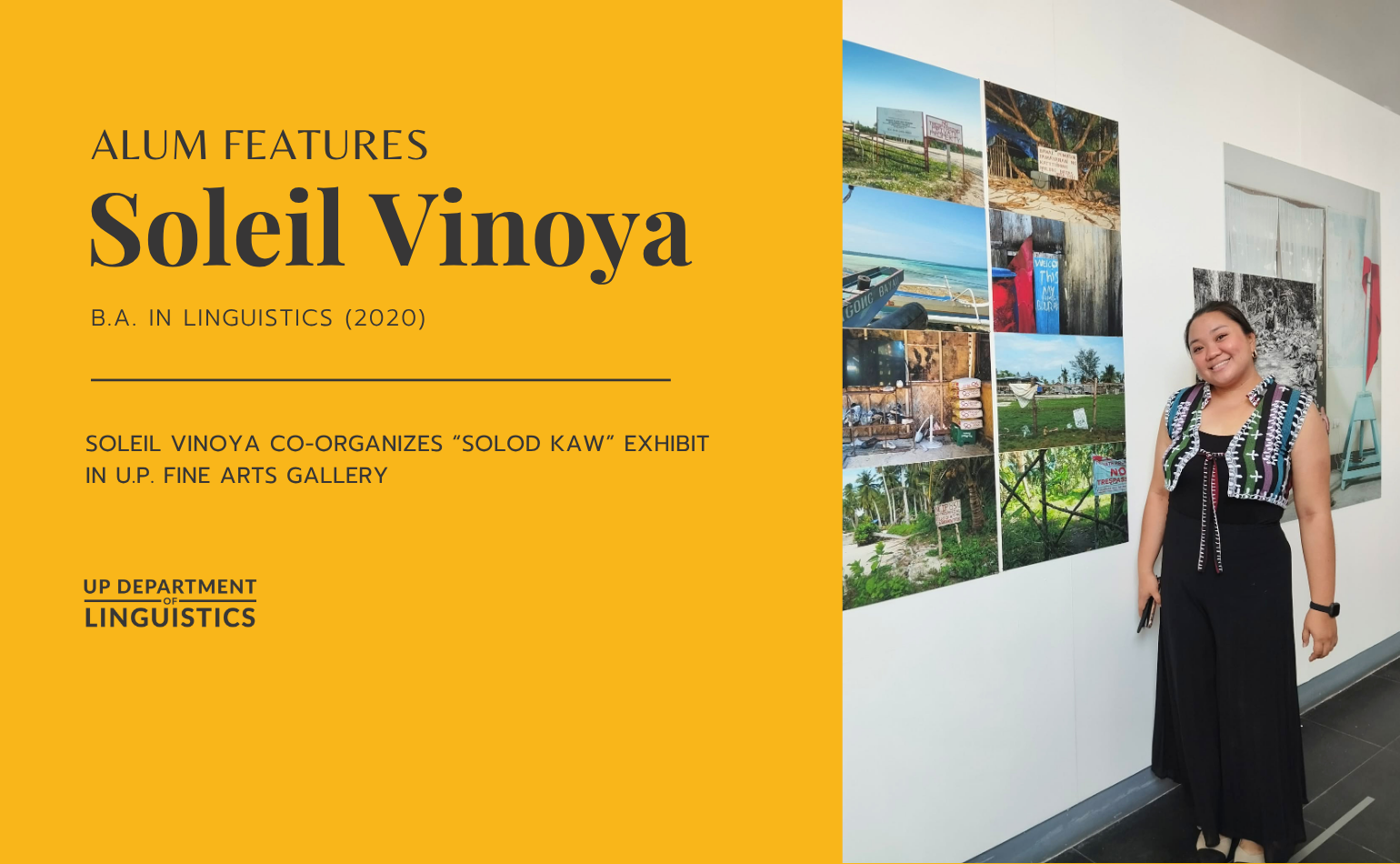
Soleil Vinoya, BA Lingg alum (2020), is one of the organizers of the “Solod Kaw: Isang Pagpapatulóy, Isang Pagpapatúloy” exhibit at the Gallery Two of the UP Fine Arts Gallery. The photo exhibit ran from 08 to 20 April 2026, and is “a special reconstruction of 1975 Bugsuk” and the struggles of families from the Cagayanen, Molbog, and Palaw’an ethnolinguistic groups who are “leading the long-standing resistance under the Sambilog – Balik Busuk Movement: Tagnato, Puring, Buliluyan, Marihangin, Pandanan, Bugsuk, and Sebaring.”
“Solod Kaw” is part of Fair Finance Philippines (FFPh)‘s divestment campaign, and the organization “supports the call of Sitio Marihangin residents for corporations and financial institutions to divest from harmful projects that contribute to human rights violations and displacement of indigenous communities from their ancestral lands.” Read on below for our interview with Vinoya.
Please give us a brief summary of your endeavors after graduating from the BA program.
Vinoya: “After graduation, I started working in IDEALS. IDEALS is the NGO where I still work now. I’ve been working with IDEALS for five years now […] Then, I left for a bit to pursue my Masters in Human Rights in Mahidol University in Thailand. It’s a joint masters so I also took units in the University of Colombo, Sri Lanka. Right now, I’m still finishing up my thesis and I came back to the Philippines in 2024 to start working again in IDEALS, and this time I was assigned to the economic rights program. The FFPh is under this program, and we started the campaign in December 2024.”
What started the collaboration with the community?
Vinoya: “Before this exhibit, we made a film that is also being shown here. This film was an ethnographic film focusing on the struggles of Marihangin when there were blue guards there who wanted to evict residents. We shot the film in collaboration with the children, and they took footage using digicams and interviewed other residents. After that, this whole exhibit is a collaboration with the community as this would be impossible to do without them. Everytime that we stay in the communities, we would have a contact person who would connect us with the residents and help us arrange for transportation and lodging.”
Can you share with us the fieldwork process for the exhibit?
Vinoya: “When we were doing the film, we stayed in Marihangin for about eight days. Before we go there, we would have planning sessions and long preparations for the logistics. And then, when we go to the area, the transportation from Puerto Princesa to the port is about six hours by van. After that, going to Marihangin would then take about one and a half to two hours by boat – depending on the weather. The community helped us in the arrangement of the boat as they were very wary of unfamiliar boats.
[During the fieldwork proper] we would ask to sleep in the houses of the residents. Sometimes, a space is prepared, but recently, we bought our own hammocks and placed them on locations approved by the community. We would wake up at around 6:00 to 7:00 AM as most of the community would also be awake for a long time now at that time as they would just return from fishing trips. […] You can go around the whole of Marihangin in around five hours by walking, and we did that before. During the times when we would go around the island, we would have a set destination to go to, and the trip would be quick. But, for the rest of this exhibit, what we did was to prepare an itinerary which started in Brgy. Tagnato – an area about four hours away from Puerto Princesa. We stayed there for two days, and the first thing that we did was to have casual conversations with residents. We also did a courtesy call at the different Barangay Halls. After that, we would spend time talking with the community and share and listen to stories. We would then eat together, and more stories would be shared during these activities.
The community members then guided us to their sacred spaces, so we were able to get to the cave [shown in the exhibit] after a short hike. […] They showed us their different practices, and we sometimes stopped at healers’ places.
[…] In total, we had three trips to the location – in January, February, and March – but we still felt that the duration was short as we had to do many activities and take many shots. We also actually didn’t know how to condense all of the things that we have into one exhibit.”
To people doing similar work and looking into collaborating with communities, what advice would you give?
Vinoya: “What I’ve learned from this whole process is that listening always comes first. We first need to know what the community went through. One needs to be very good at listening […] and the community needs to be comfortable with you. Pakikipagkapwa is very important. Then, sometimes, you don’t know what will happen once you enter the area, so you will have to be ready for different things like walking and hiking. All in all, you just need to participate in what the community members do and go through everyday.”
What would be the next steps after this exhibit?
Vinoya: “This exhibit was meant to be the culmination of the project. But right now, we’re still hoping that this continues, and there are some people who are interested in bringing this exhibit to other places like other universities.”
—-
Soleil Vinoya is one of the photographers during the fieldwork, and along with the community members was one of the people who explained to visitors the rationale and contents of the exhibit. More information on future locations of the exhibit may be found at the official Facebook pages of FFPh and Sambilog – Balik Bugsuk Movement.
Published by UP Department of Linguistics