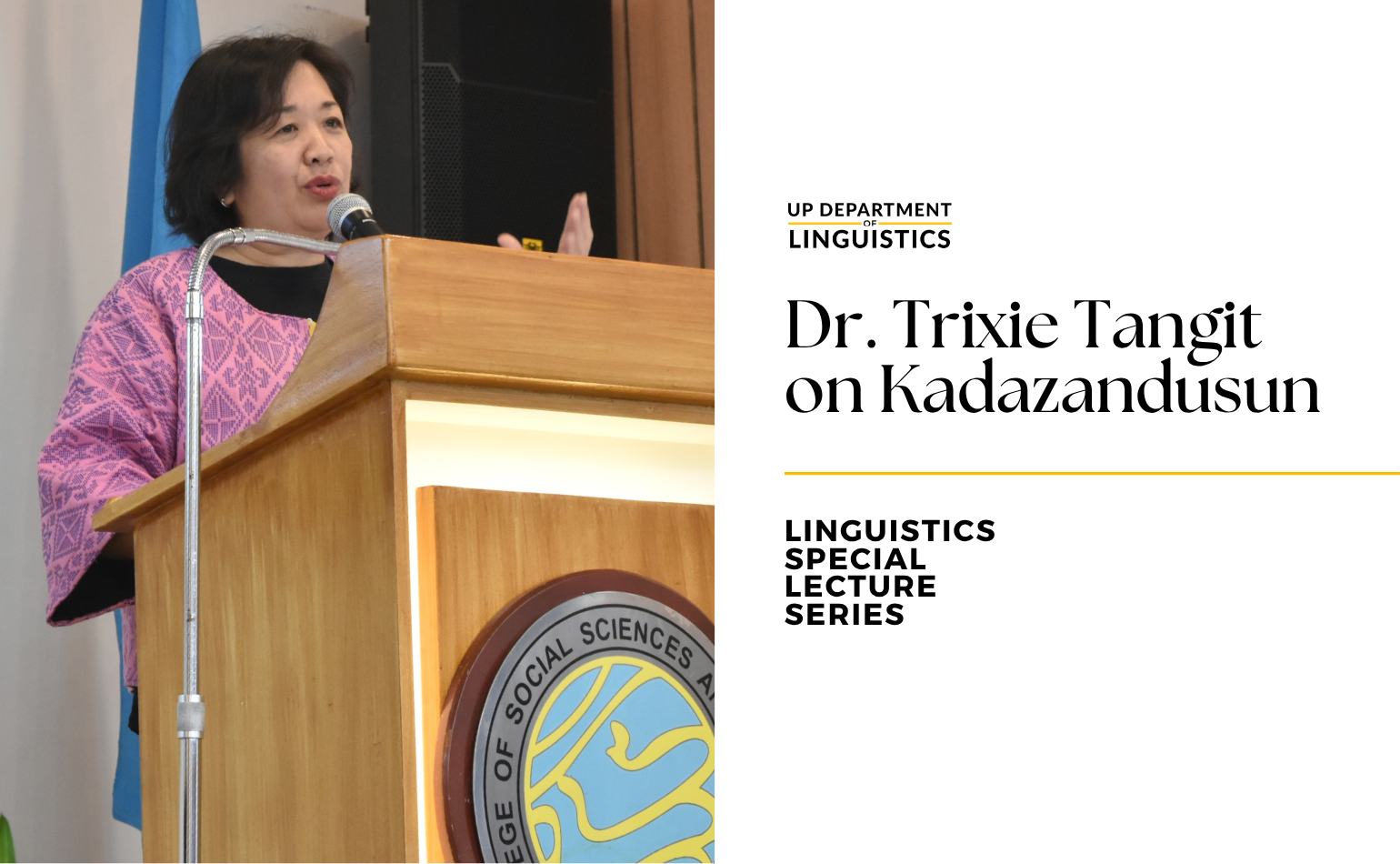
Dr. Trixie Marjorie Tangit, lecturer at Universiti Malaysia Sabah, gave a talk entitled “Tahanan: Sanctuary or Cage? Language, Identity, and the Engineering of Belonging – The Case of the Kadazandusun“ last 17 September 2026 at the Pilar Herrera Lecture Hall. This was the fifth installment of the 2026 Linguistics Special Lecture Series (LSLS), and was co-organized with the UP Department of Anthropology. LSLS 5 is part of the celebration of the 104th founding anniversary of the UP Department of Linguistics.
In the talk, Dr. Tangit discussed the development of Kadazandusun, a language from a combination of different dialects. This label was constructed in an attempt to present a unified identity of the indigenous people of Sabah, a state in Malaysia with diverse cultural and ethnic groups resulting from migration and contact with other countries, such as the Philippines and Indonesia. Dr. Tangit also explained the concept of “Malayanising” and how this is tied to creating a sense of belonging among the Sabahans, given the different religions and cultures of the ethnic groups in Sabah.
Kadazandusun is perceived by many as a combination of two languages: Kadazan and Dusun. They come from the same language family, but the linguistic groups occupy different social positions. The term “Dusun” was a stigmatizing label from British colonizers, referring to the people inland or in rural areas as ‘uncivilised.’ On the other hand, the “Kadazan” were considered the citified Dusun and the term is often associated with urban development and prestige. In terms of language development, Dr. Tangit discussed how the people of Kadazan sought to develop their language since the 1950s, being present in printed books and radio broadcasts. The language of Dusun had also been present in various texts and media. Around the 1960s and the 1970s, there was a decline in mother tongue usage as people felt compelled to speak Standard Malay and English given the incentives brought by the position of these languages in society. By the 1980s, the Kadazan language had been emphasized for standardization and was petitioned as the language of instruction in schools as part of the implementation of Mother Tongue Education, but it led to a conflict with the language planners of Dusun that could not be resolved. In 1995, the term “Kadazandusun” was agreed upon by the Kadazan Dusun Cultural Association (KDCA) and the United Sabah Dusun Association (USDA) in response to the discourse on the medium of instruction in schools and the perceived need for a marker of a collective identity in Sabah. According to the agreement of the cultural associations, the Kadazandusun language uses two Dusun dialects as the base and the other languages in Sabah, including Kadazan, as enrichment. Although the two are similar in structure and lexicon, there are significant differences especially in their phonology or sound system. The Kadazan language is notably more phonologically complex than Dusun and has sounds that are not present in the other, such as implosives and voiced fricatives. The Kadazandusun language was to be taught in schools, but there were controversies surrounding it because it seemed to sound primarily like Dusun seemingly neglecting the Kadazan identity and its history. However, many parents wanted to retain the Kadazandusun language as the medium of instruction in schools, as it was already being learned, and prevented a drastic decline of indigenous language use among the younger generations.
Dr. Tangit also talked about the development of the Kadazandusun identity and how it parallels the development of the Kadazandusun language. Dusun was one category during the colonial period until the emergence of Kadazan as an additional category in 1960. The two categories eventually merged into Kadazandusun. As with the language, there are also controversies regarding this created identity. In 2024, there was a movement to replace Kadazandusun and promote “Momogun” to assert the people’s rights as inhabitants and develop the economic aspect of the state. Some wanted to return the use of “Kadazan,” and some preferred the term to be simply “Sabahan.” Nonetheless, Kadazandusun is created as a large indigenous category to distinguish itself from other ethnic groups, but there is much difficulty in asserting an identity marker because the people of Sabah have mixed cultures from migration, contact, and a high rate of intermarriages. Dr. Tangit further elaborated on this by discussing her Sino-Kadazan heritage, wherein she emphasized that having more than one identity provided more stability for some people because it allows them to choose their ethnic identity according to different social contexts, making the Sabah identity fluid.
Notably, while the Tagalog tahanan pertains to ‘home’, the Malay tahanan refers to a ‘detainee’ or ‘prison’, with its root tahan meaning ‘to endure’. Dr. Tangit concluded the talk by highlighting how language standardization can cage and restrict us to a particular identity, but the bars are bendable because there is home, where you speak any language you are comfortable in using and be yourself.
Photo by Corinne Cedo
Published by Janna Isabel Basila