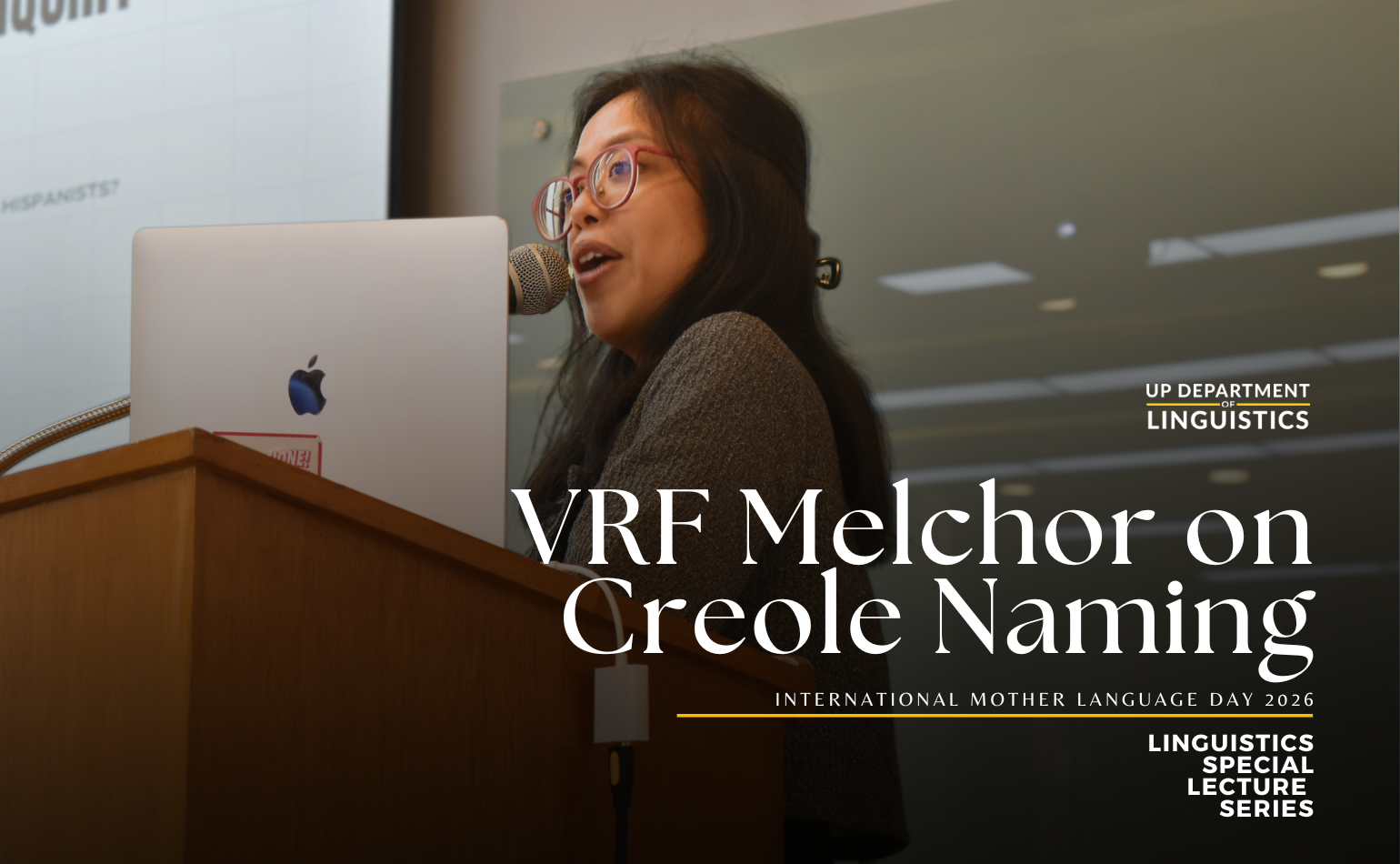
Last 19 February 2026, Visiting Research Fellow Jillian Louise Melchor, doctoral researcher at the University of Helsinki, presented a talk entitled “What do we talk about when we talk about Chabacano? The socio-politics of creole naming and language description” as part of the 2026 round of Linguistics Special Lecture Series (LSLS). This talk is a part of a back-to-back LSLS in celebration of the International Mother Language Day (IMLD) 2026. The talk was originally published as “What do we talk about when we talk about Chavacano? Language Names in the Archaeology of Knowledge” on the Journal of Pidgin and Creole Languages and is the first of an ongoing four-article research project on the topic.
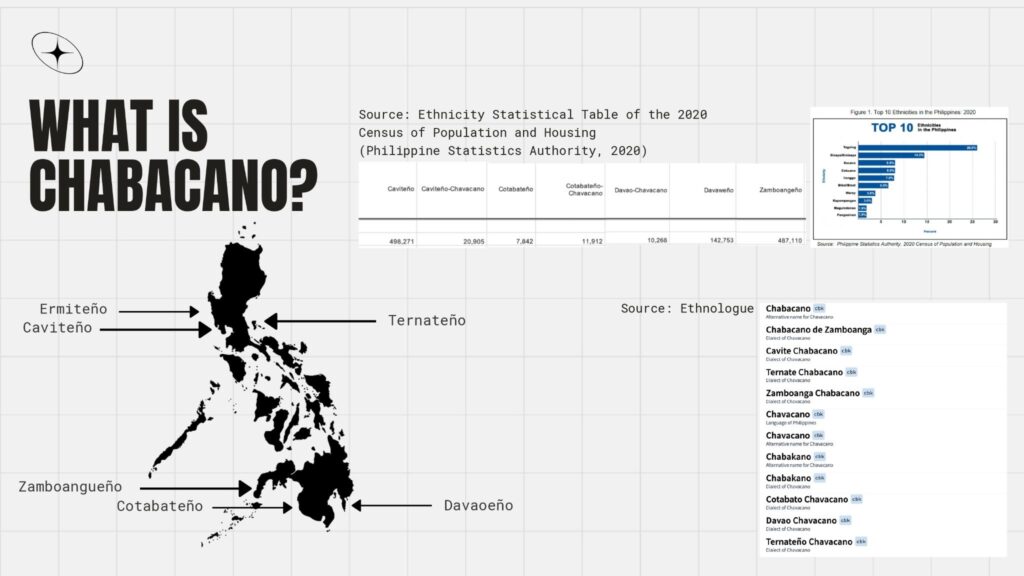
The talk problematizes the use of Chabacano as a label for the only Spanish lexified creole in Asia. A name of a language may not seem significant at first glance; however, names themselves can carry political and social implications as well as dictating cultural borders. The giver of a name is also considered an important entity, as this indicates that the giver is in a “higher” position over those who are being named. This is especially problematic when a name is imposed on a group. Usually, the entities that impose names or acquire the right to give names are the colonizers (in the past), and the linguists and the speakers themselves (in the present).
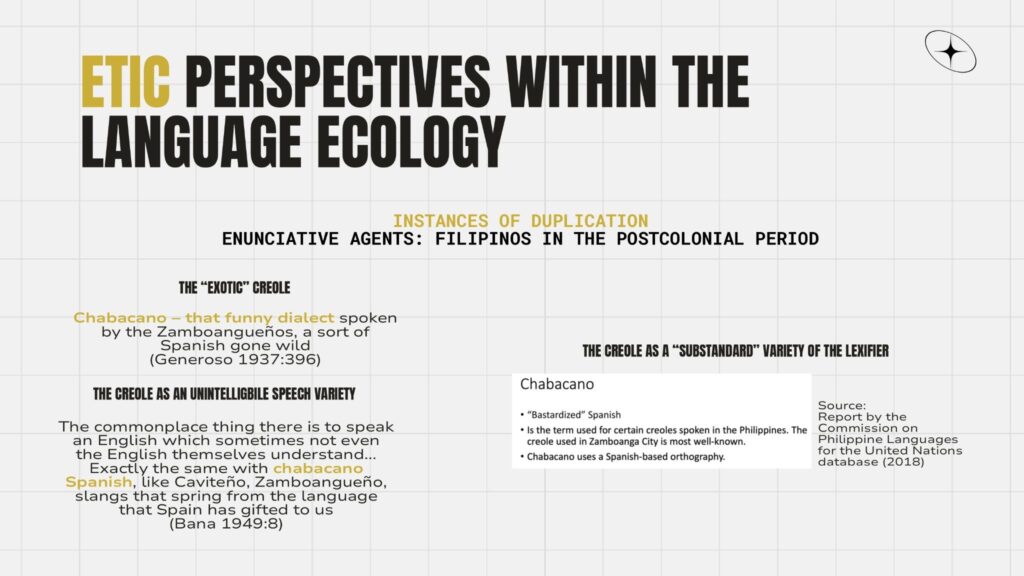
The name Chabacano came from the Spanish word chabacano, which means ‘something executed in an unpolished manner’, ‘without corresponding mastery’, and therefore, ‘anything unworthy of praise or recognition’. Thus, Chabacano was considered a “corrupt” variety of Spanish. Thee term was also used to look down on the people speaking it, and became at once, a justification for colonization. Despite the negative evaluation of the word, currently, speakers of the language do not reject this term and in fact, celebrate it.
Currently, Chabacano is still somewhat seen as a “corrupt” language, especially by Hispanists and other non-speakers. Nevertheless, Chabacano linguists have been pushing back on this narrative, and write papers about Chabacano without the negative prejudice. Speakers of the language have thoroughly reclaimed the name and consider it a part of their unique history and heritage.
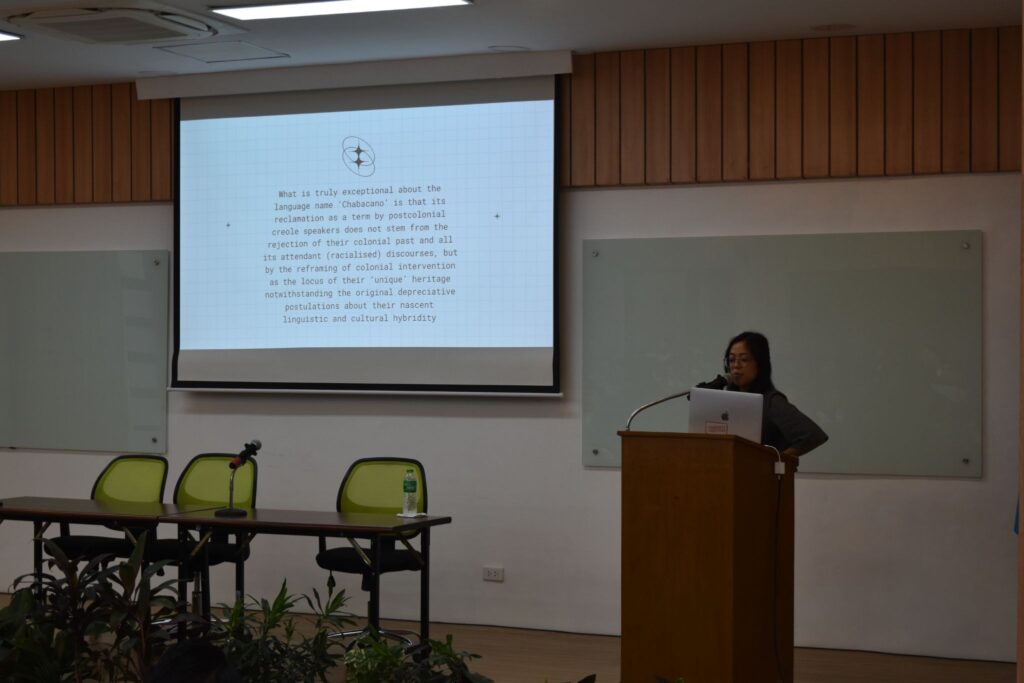
After the talk, a question and answer session with the audience was held. Questions related to Chabacano orthography, emergence and eventual acceptance of the language for the speakers, as well as some about how to go about with making a corpus for the language.
The recorded version of the talk can be seen on the Department’s official YouTube channel. The 2nd installment of the 2026 LSLS was also livestreamed on the channel. The LSLS features talks by invited experts on various topics under the fields of theoretical and applied linguistics.
Published by Romina Joyce Y. Buan