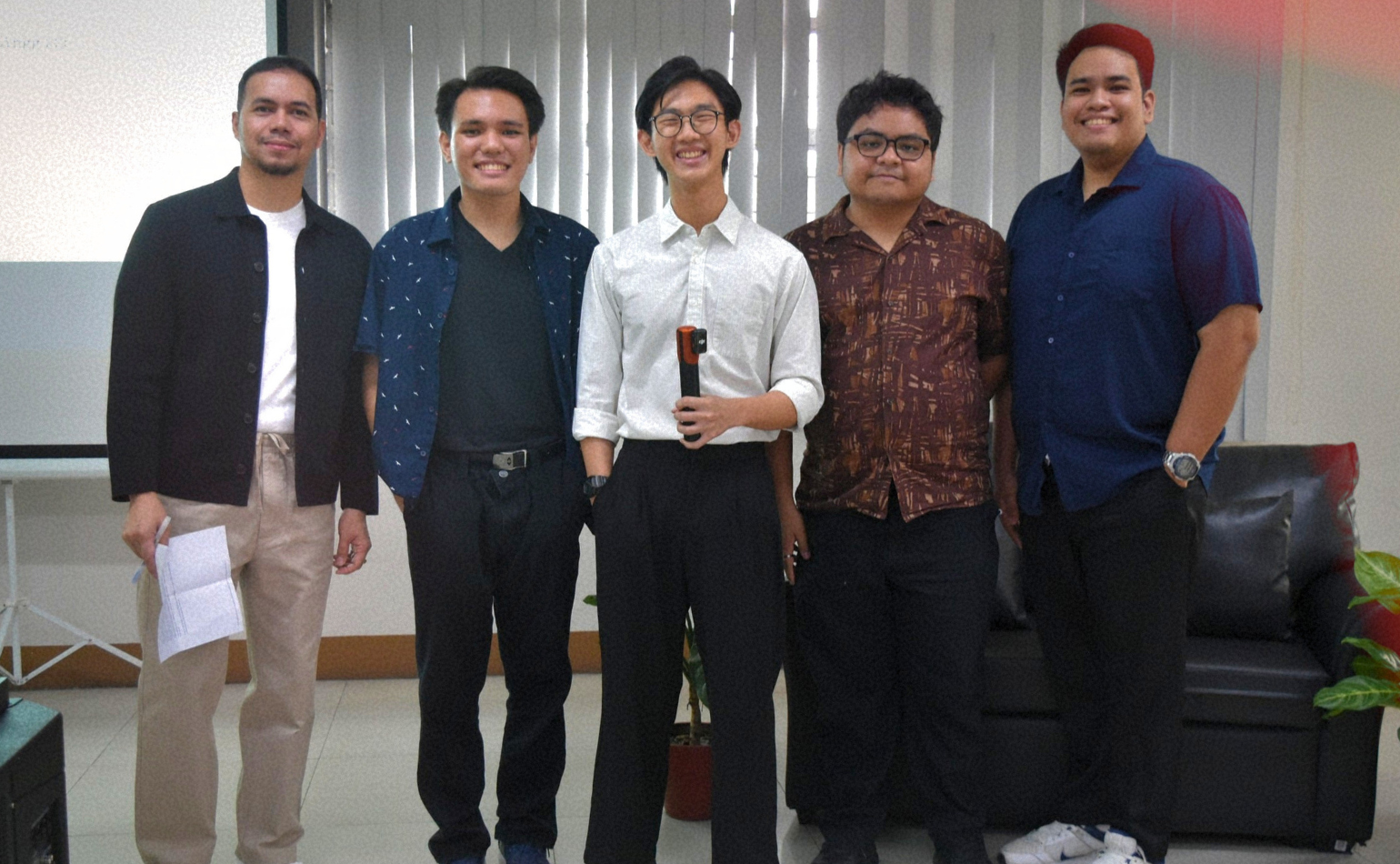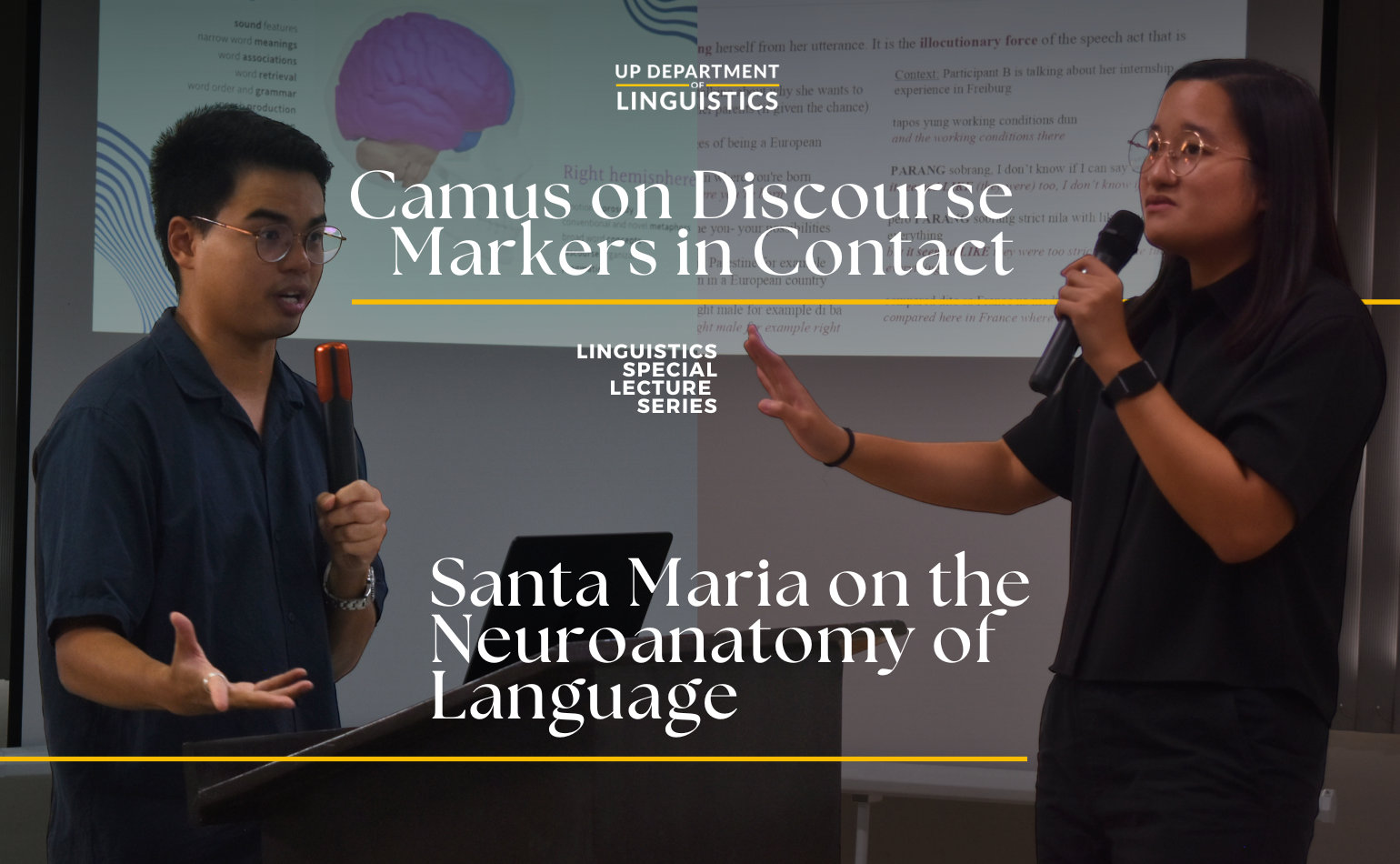
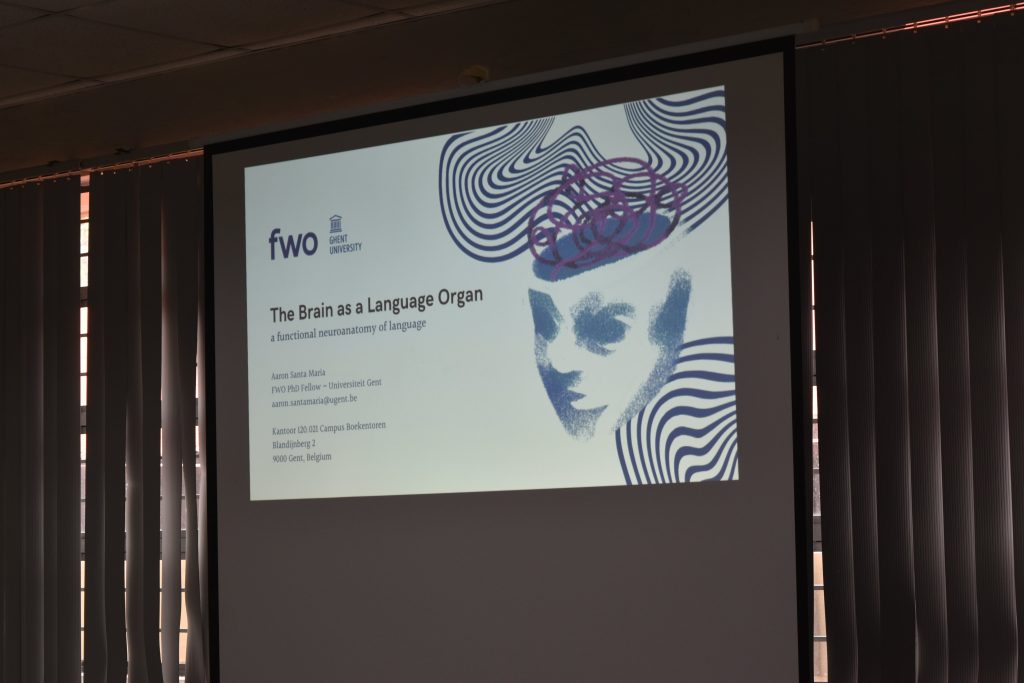
Last 10 September 2025, visiting researcher fellows Aaron Sta. Maria (PhD fellow at Ghent University) and Patricia Camus (PhD Student at Université Paris Cité and BA Lingg Alum) presented back-to-back lectures for the 6th and 7th installments of the Linguistics Special Lecture Series. Their presentations were entitled “The Brain as a Language Organ: a functional neuroanatomy of language” and “Discourse Markers in Contact: Investigating “Like” and “Parang” in Tagalog-English Bilingual Speech” respectively.
Sta. Maria on the Neuroanatomy of Language
The first lecture was by Sta. Maria, who started with an interactive activity where he invited the participants to identify certain parts of the brain. This is an engaging activity to familiarize the audience members with the brain anatomy. This part also tested the audience’s knowledge on the different functions of each part of the brain, especially those that are related to language. Some parts of the brain mentioned were Wernicke’s and Broca’s area, which are famously known to be responsible for language comprehension and production, respectively. He would later explain why these classical views are outdated in the field of neuro- and psycholinguistics. He also briefly explained terms such as “superior” and “inferior”, “anterior” and “posterior”, and “lateral” and “medial” which are used in describing the brain anatomy.
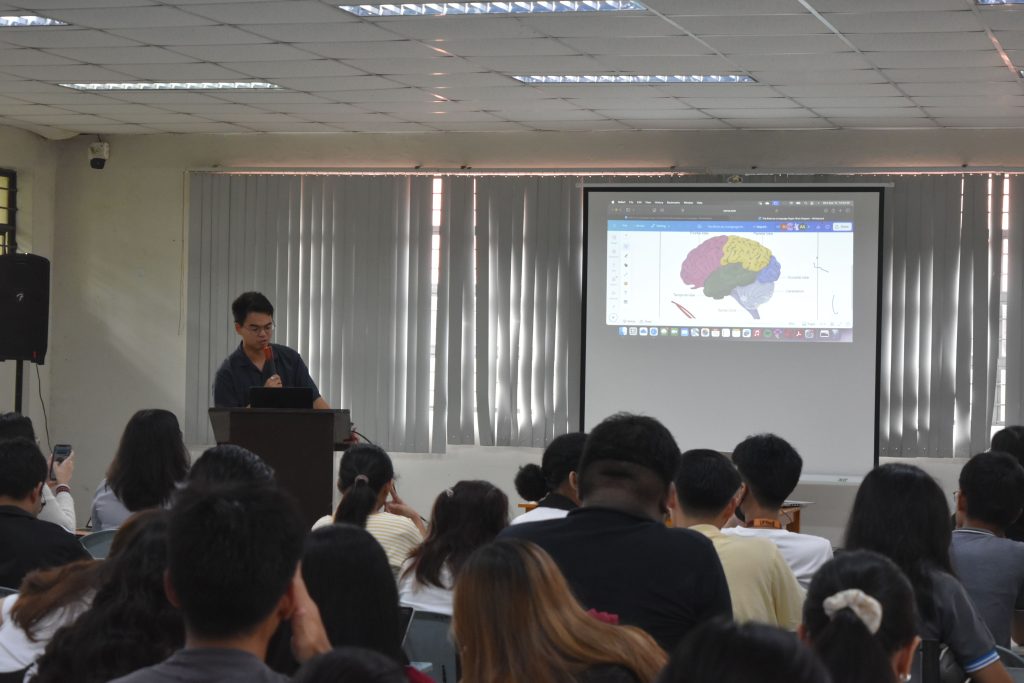
After familiarizing the audience with the structure of the human brain, Sta. Maria discussed the classical view of how neurolinguists understood brain functions relating to language. The first was the belief that the syntax was located in one part of the brain, called the Broca’s area, after Paul Broca had a patient who had language production problems which was traced back to a damage in a certain part of the brain through a post-mortem analysis. Another part of the brain popular in the world of linguistics is Wernicke’s area which is associated with speech production. Patients with damaged Wernicke’s area have problems with nonsensical speech. Because of these findings in the late 1800’s, it was widely accepted for a long time that these two parts are largely responsible for language.
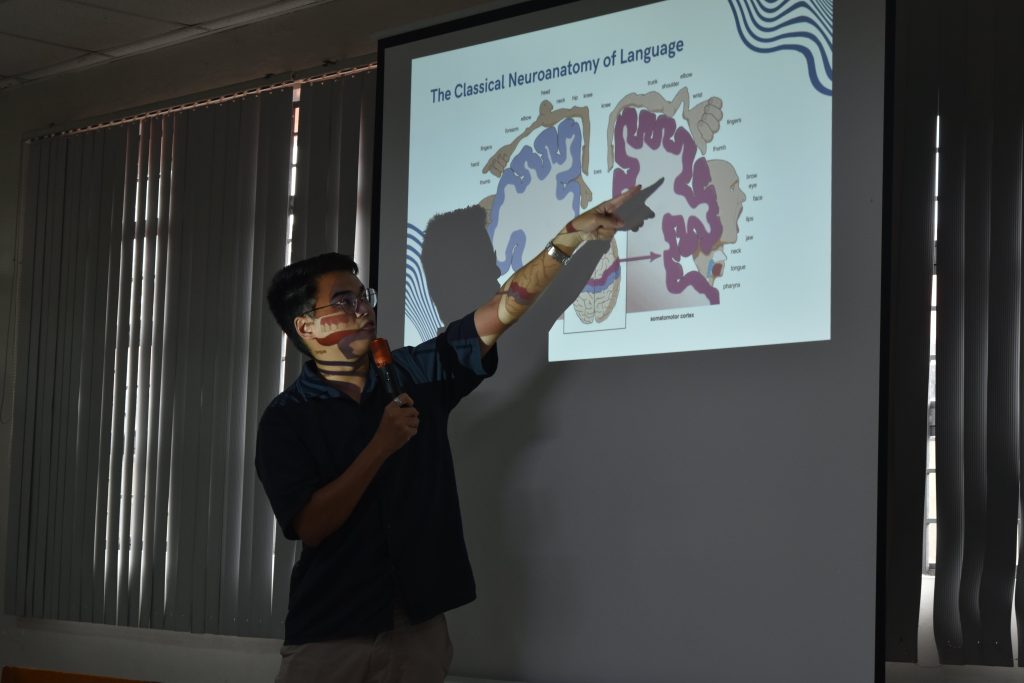
Sta. Maria then explained how recent research in neurolinguistics have lead to development of newer theories; language in the brain is much more complicated than is previously believed to be. These newer findings are discovered thanks to various non-invasive and invasive research methods. Some things researchers look for are the levels of brain activity in different areas measured by varying oxygen levels, electric currents, and white matter which are tracked using non-invasive methods. Invasive methods employed in neurolinguistic research include electrocorticography, direct electrical stimulation, and language testing during neurosurgery. The common goal for employing such methods is to map which parts of the brain are healthy and not, and how certain damages affect speech and comprehension. One of the topics he also discussed how the right hemisphere of the brain is more responsible for expression emotions through tone and prosody. The same part is also apparently responsible for creativity, hence processing meanings of metaphors. All these basically mean that more areas in the brain are involved in language processing that was previously known.
Camus on Discourse Markers in Contact
The next lecture was delivered by Patricia Camus, who presented her preliminary analysis of the discourse particles like and parang in Tagalog-English bilingual speech.
She began by defining discourse particles, which she described as having a “less solid” definition compared to other linguistic concepts. Discourse particles come from varied class of linguistic items which work as function words, but adds meaning and improves coherence of a speaker’s utterance. She also highlighted that discourse markers are very susceptible to contact-induced changes, and are ranked third as the most borrowable category.
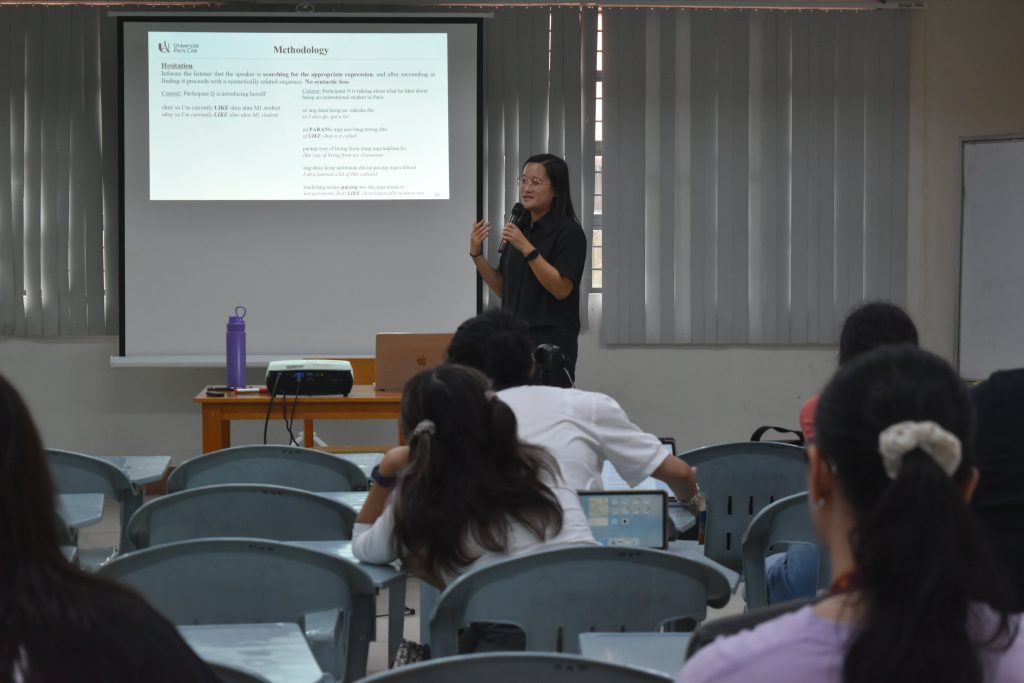
In this talk, she presented some findings from her corpus analysis based on two corpora—the TenTen Tagalog corpus from 2019, and an own corpus of spoken interviews consisting of almost 8 hours of recording. She focused on two particular discourse particles—like and parang. She started by presenting the question of whether the use of like is considered as code switching or as borrowing. In case of borrowing, it would also be important to identify if there is a process of grammaticalization happening. Another question she aims to answer in this research is if these two markers have overlapping or complementary functions.
The first finding is about the structural position of the particles in question. Camus stated that both like and parang are mostly found clause-initially, then the next preferred position is clause-medial, and then peripheral. The next is about the function of these particles. In this part, she also pointed out the discrepancy in existing literature between the two particles, stating that there are way more available data for the particle like than for parang. Additionally, she mentioned that parang has historically been described only as a comparative or resemblance marker to describe similarity; it has not been analyzed as a discourse marker.
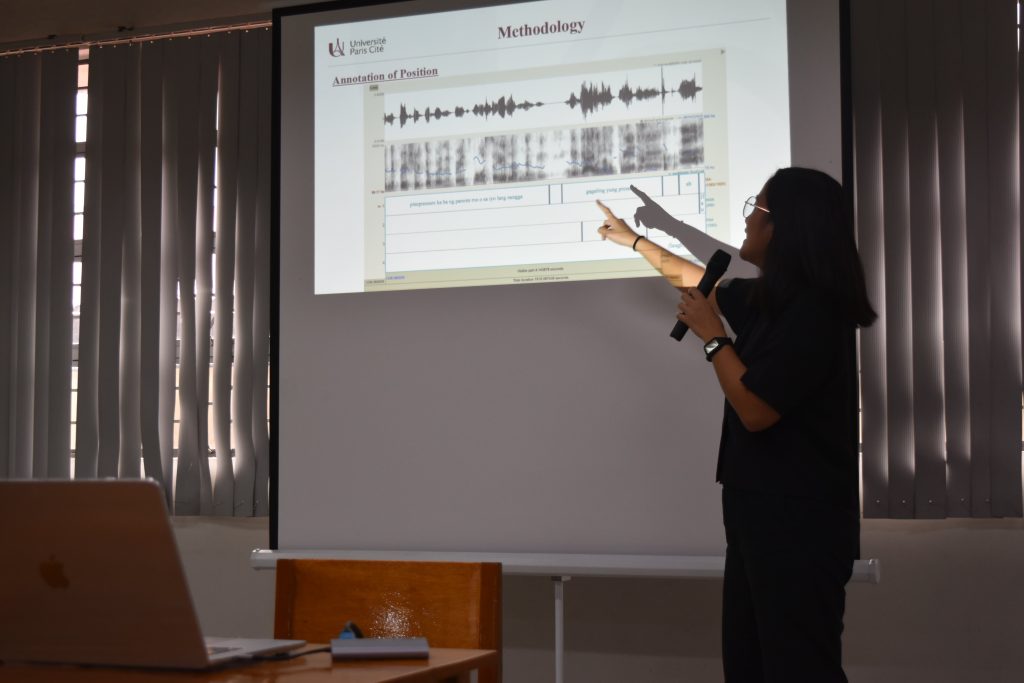
In her study, Camus identified the following functions of both particles: specification, hesitation, epistemic hedge, pragmatic hedge, quotative, and comparative, for each she also presented examples of utterance extracted from the corpora she analyzed. Finally, she also looked into the immediate language environments in which the discourse particles occur—she classified four difference language environment: Tag-Eng, Eng-Tag, Tag-Tag, and Eng-Eng. Here, she highlighted an interesting instance where like and parang occurred together in a fully English utterance, this however only occurred once in the entire corpus that she analyzed.
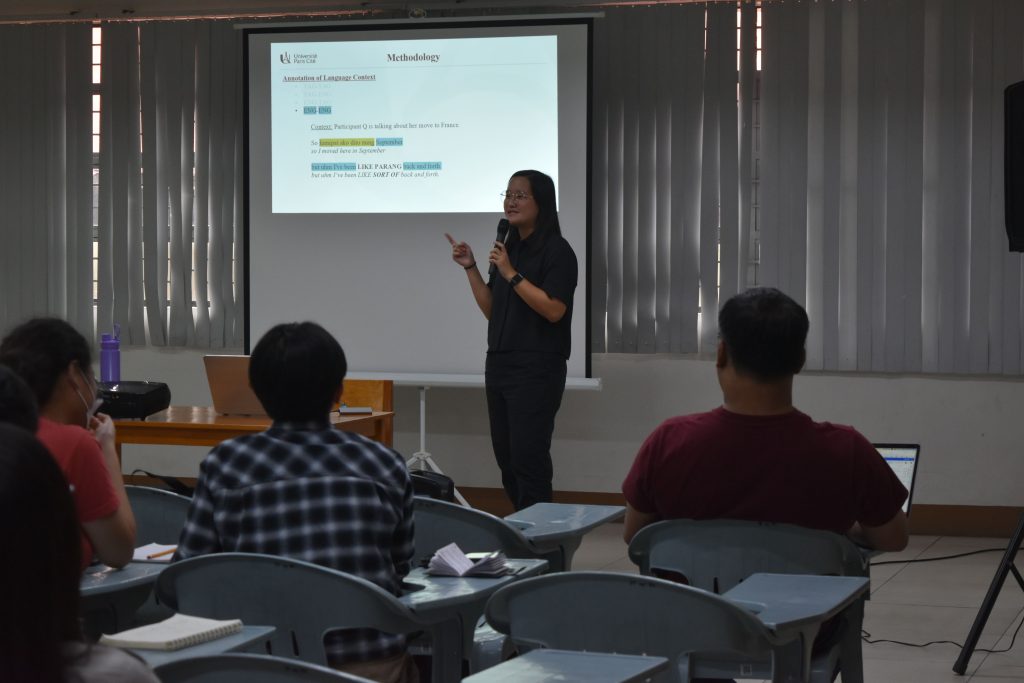
Camus ended the lecture by emphasizing the need for a bigger and more representative corpus to come up with a more comprehensive descriptions of function of the discourse particles she is studying.
Each presentation was followed by a question and answer portion which allowed the audience members to engage with the speakers, ask for any clarification, or give feedback for the lecture. The recorded lectures can now be viewed on the official Department Youtube channel.
Published by Katrina Joyce S. Jose