
Mobility and migration have long been at the forefront of innovation, discovery, and paradigm shifts in human history (Hollifield, 2023; McAuliffe & Oucho, 2024). English, for example, was shaped into its current form and established its status as the global lingua franca through the migration of the Anglo-Saxons and Normans to Britain, as well as the British across the globe. Historical forced migration, such as the Atlantic slave trade and coolie labor, shapes the present-day demographics of the destination countries. At the individual level, Nobel laureates Albert Einstein, Enrico Fermi, and Roald Hoffmann are also migrants.
Likewise, in the present era, migrants continue to reshape the social, political, and economic landscape, despite the relatively smaller proportion, which is 281 million, or 3.6% of the world’s population (McAuliffe & Oucho, 2024). For instance, half of the American recipients of the 2025 Nobel Prize in science are migrants. Similarly, tech giants’ leaders, such as Google co-founder Sergey Brin, incumbent CEO Sundar Pichai, and Tesla’s Elon Musk, are also migrants. Migrants or their descendants have been elected as leaders in major destination countries and cities, such as the 44th United States President Barack Obama, 49th Vice President Kamala Harris, former United Kingdom Prime Minister Rishi Sunak, and, most recently, New York City Mayor-elect Zohran Mamdani. In this context, linguistic diversity has never been more relevant in contemporary society. For instance, there are more than 600 to 700 languages reportedly spoken in New York City. In Toronto, one’s 911 call can be responded to in more than 240 languages. Taken together, human mobility has never been greater than ever.
[…]
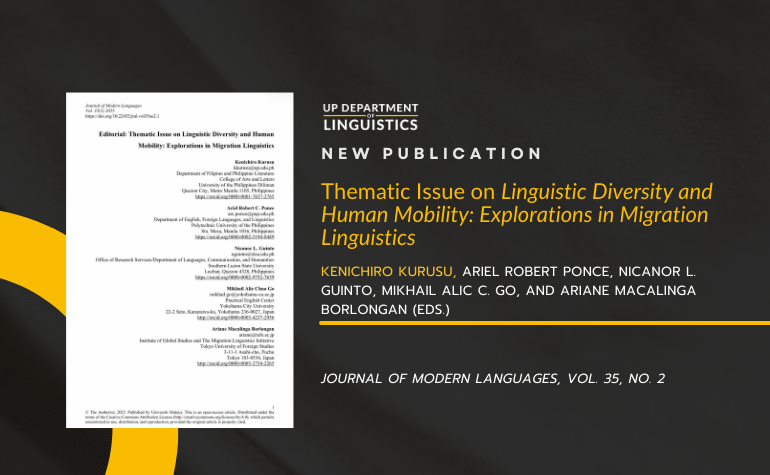
- Author: Ken Kurusu
- Co-author:
Ariel Robert Ponce, Nicanor L. Guinto, Mikhail Alic C. Go, and Ariane Macalinga Borlongan
- Publication Date: 2025, December 22
- Publication Type: Editorial Article
- Published In: Journal of Modern Languages, Vol. 35, No. 2
- Topics: Sociolinguistics, Migration linguistics
- Link: https://ejournal.um.edu.my/index.php/JML/article/view/66930